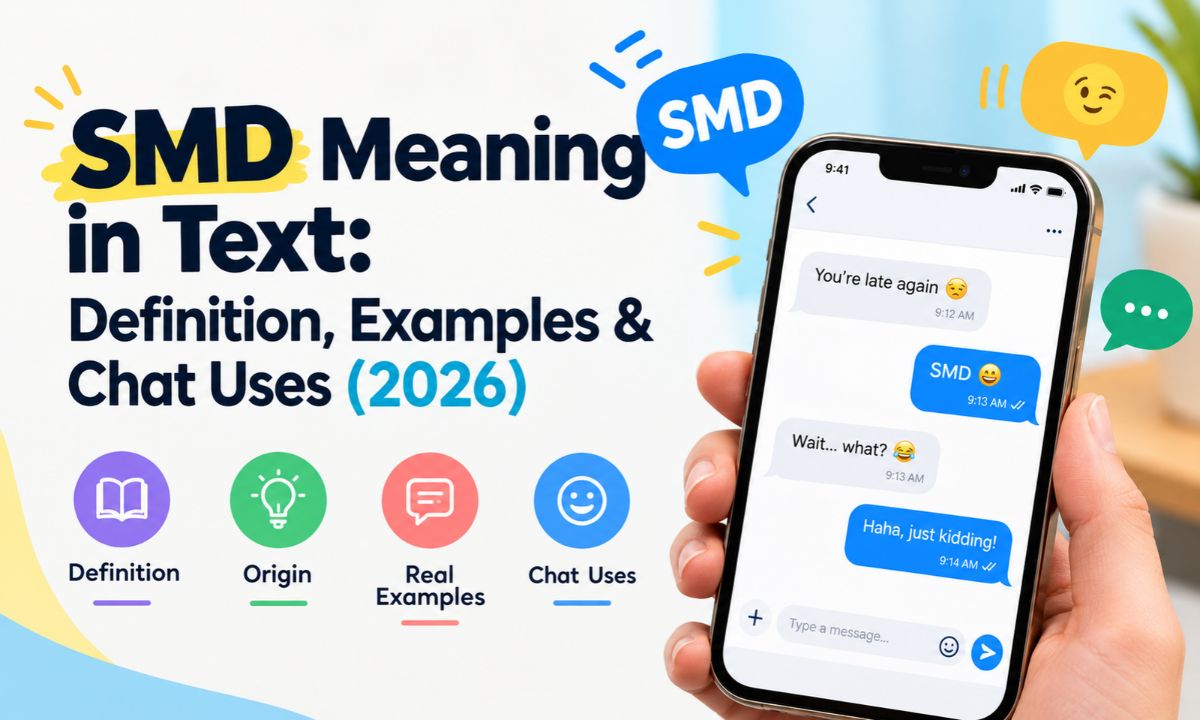
Few abbreviations cause as much confusion as SMD. You scroll through a group chat, a comment section, or your direct messages, and there it is: three capital letters with no explanation. If you have ever wondered whether SMD was a joke, an insult, or a typo, you are not alone. This guide explains what SMD meaning in text, where it came from, how people use it in 2026, and how to respond without making things awkward.
A quick warning first: this is vulgar slang. It is not appropriate for school, work, or conversations with people you do not know well. Understanding it, however, helps you read online conversations correctly.
SMD – Quick Meaning
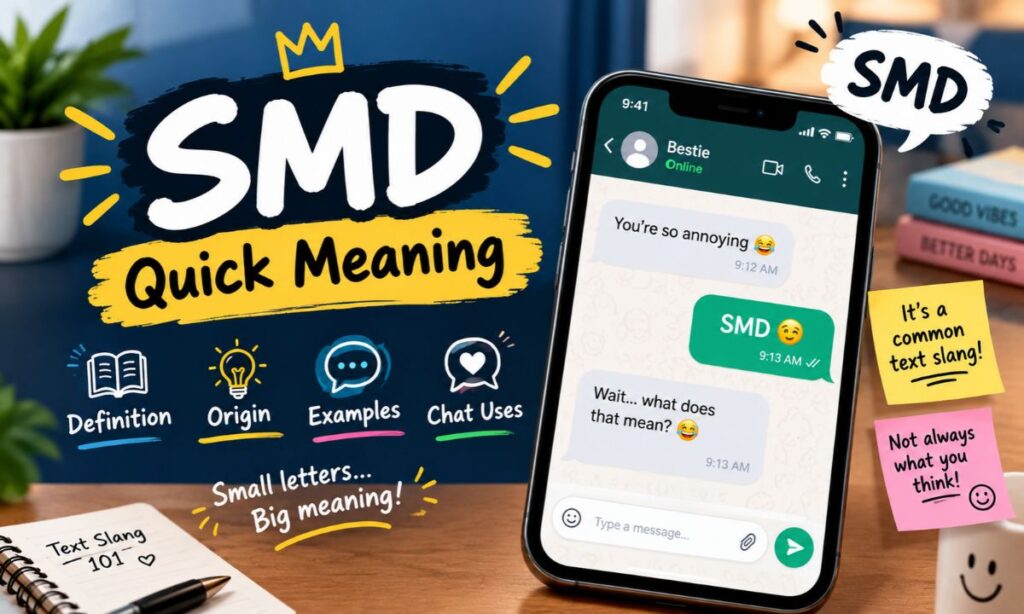
Simple definition
SMD is shorthand for a crude phrase, “suck my d***.” In most chats it is a rude way of telling someone to back off, get lost, or stop pestering you. It carries the same energy as other blunt dismissals, only more explicit and more offensive.
Among close friends, people sometimes use the abbreviation playfully, as an exaggerated way of saying “you’re annoying me” or “I can’t believe you just said that.” Tone, relationship, and context decide whether it lands as a joke or an insult.
Quick examples
- “You want me to pay for your ticket again? SMD.”
- “Bro, you ate my fries and now you want more? SMD.”
- “Everyone says I’m wrong, but I’m not changing my mind. SMD.”
In each case, the sender is dismissing something, whether a request, a complaint, or an opinion.
Origin & Background of SDM Meaning
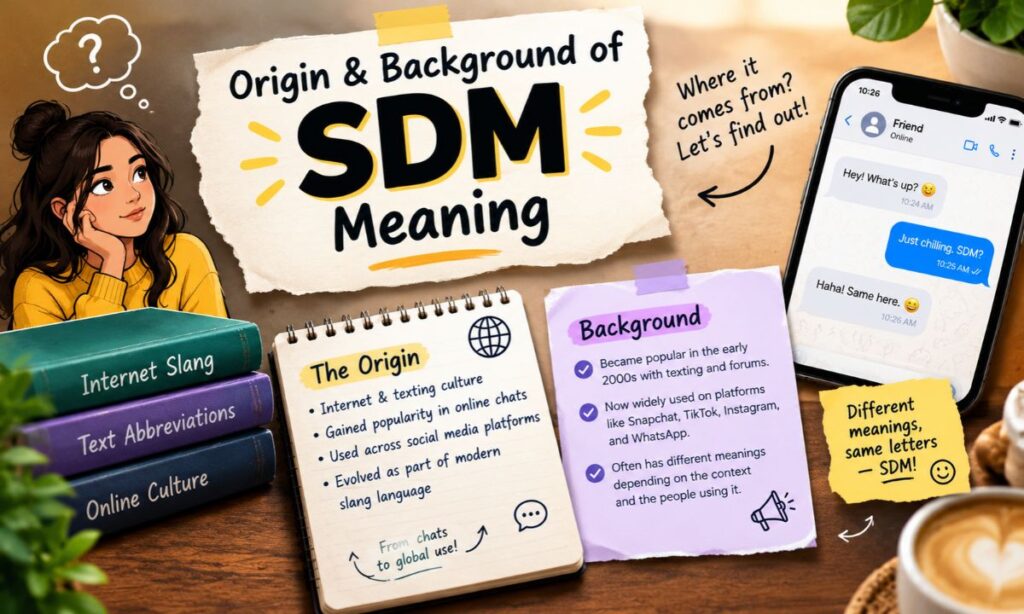
Early internet culture
Abbreviations like this grew out of the early days of chat rooms, text messaging, and online gaming. When every character cost time or money, people shortened everything: “BRB,” “LOL,” “TTYL.” Crude phrases got the same treatment. Typing a full vulgar sentence felt heavier than typing three letters, and the abbreviation also let people dodge basic word filters on forums and in-game lobbies.
SMD grew out of that environment, particularly in competitive gaming chats, where trash talk was constant and speed mattered. Players used it to dismiss opponents, wave off criticism, or add a bit of aggression to a message without writing the whole phrase.
Influence of social media
When platforms like Facebook, Twitter, Instagram, Snapchat, and TikTok took over everyday communication, slang spread faster than ever. A term that once lived in a few gaming communities could suddenly appear in millions of comments. On social media, SMD spread through memes, reaction posts, and heated comment threads, and each wave of new users picked it up without always knowing its history.
By 2026, short-form video comments and fast-moving group chats keep these abbreviations alive. They are quick, expressive, and easy to type with a thumb. That convenience is the main reason the term has not faded.
Real-Life Conversations
WhatsApp conversation
Friend A: Bro, you’re coming to my cousin’s wedding, right? You promised.
Friend B: I have three exams that week, man.
Friend A: Excuses. You always bail.
Friend B: SMD 😂 I’ll be there for dinner, relax.
Here the abbreviation is clearly teasing. The laughing emoji and the compromise that follows show the mood stays friendly.
Instagram DMs
User 1: Saw your story. You really think that team is winning the league?
User 2: Obviously.
User 1: Dream on. They can’t even defend.
User 2: SMD, check the table.
Now it is sharper. User 2 is shutting down the argument rather than joking, and the tone sits somewhere between banter and irritation.
TikTok comment section
Commenter 1: This recipe is trash, nobody eats pasta like this.
Commenter 2: SMD, it’s my grandma’s recipe.
Comment sections tend to run hotter than private chats because strangers are talking to each other. Without relationship context, SMD usually reads as hostile in public threads, and replies can escalate quickly.
Emotional & Psychological Meaning
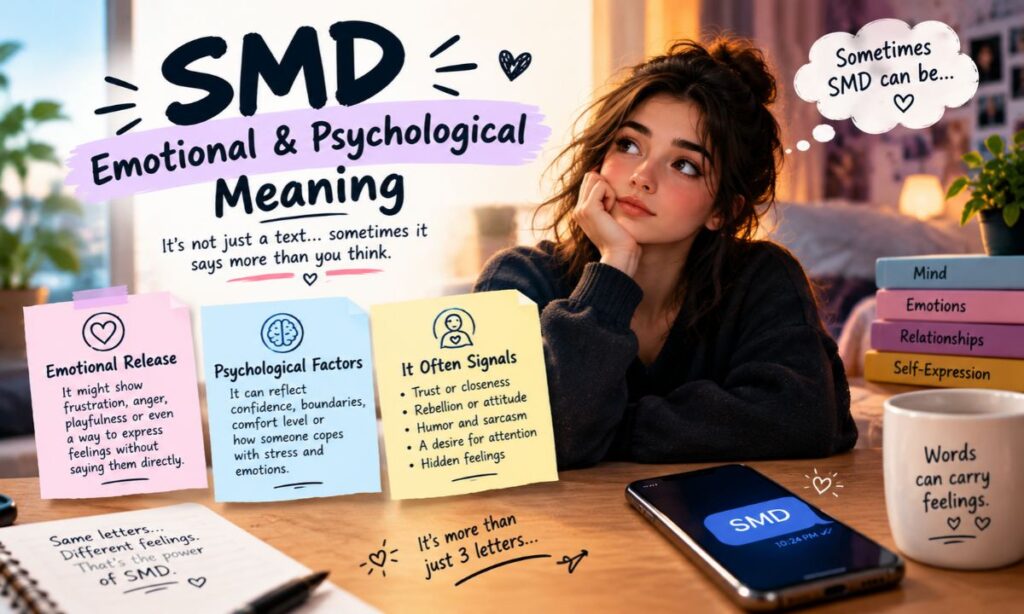
1. Frustration
Often, people reach for SMD when they are fed up. It works as a pressure valve. When someone has been nagged, criticized, or ignored, a short and rude abbreviation lets them vent without writing a long message they might regret. The brevity actually signals the emotion: “I’m too annoyed to explain.”
2. Dominance in arguments
In arguments, the phrase can act as a power move. It dismisses the other person’s point without engaging with it, which signals “I won’t even bother to respond properly.” Psychologically, this is a way of claiming status in a conversation. It also tends to end discussions rather than resolve them, because the other person feels disrespected.
3. Humor among friends
Many friend groups build humor on mutual insults. Teasing each other with exaggerated rudeness is a way to show closeness: you only talk this way to people who know you do not mean it. In that setting, SMD becomes a running joke, a signal of comfort and familiarity. The risk is that the joke only works when everyone shares the same understanding, which is not always true.
SDM Meaning Usage in Different Contexts
Social media
On public platforms, SMD appears mostly in comments, replies, and quote posts. It is common in sports debates, celebrity discussions, and gaming communities. Because the audience includes strangers, it often reads as an attack. Many platforms also moderate vulgar language, so repeated use can get comments hidden or accounts flagged.
Friends & relationships
Among close friends, this is where the term is most at home. A sibling teasing another, a group chat arguing over where to eat, friends trading jokes about a failed plan: these are typical settings. Between romantic partners, however, it can feel disrespectful quickly. Even if one person intends a joke, the other may hear contempt, which is a known corrosive pattern in relationships.
Work or professional settings
There is no good place for SMD at work. Even in a casual team chat on Slack or Microsoft Teams, using it can violate conduct policies and damage your reputation. Messages are stored, screenshots are easy, and a three-letter insult can turn into an HR conversation. If a colleague uses it toward you, save the message and consider reporting it according to your workplace’s policy.
Casual vs serious tone
The same three letters can be a joke or a threat depending on tone. In casual banter, with emojis and a history of friendly teasing, it is mild. In a serious conflict, particularly without any softening signals, it is an outright insult. A useful rule is to look at the surrounding messages: if people are laughing, it is probably playful; if the mood is tense, treat it as hostile.
Common Misunderstandings
Mistake 1: Thinking it means something polite
Because abbreviations look harmless, some newcomers assume SMD is a neutral or even friendly acronym. It is neither. Parents, younger teens, and non-native English speakers sometimes mistake it for something like “see my details” or “send me data,” and replying as if it were a normal request can lead to confusing exchanges.
Mistake 2: Using it in the wrong setting
Another common error is using the term where it does not belong, such as in a group chat with relatives, a class discussion board, or a customer service conversation. Even people who understand the meaning sometimes forget how public or permanent their messages are. When in doubt, spell out a polite version of what you mean.
Mistake 3: Assuming it’s always hostile
The opposite mistake also happens. Not every use is an attack, and treating a joke as a threat can make you look overly sensitive or start unnecessary drama. Reading context, relationship, and emojis helps you judge the real intent.
Comparison Table
| Term | Meaning | Tone | Safe at work? |
|---|---|---|---|
| SMD | Crude dismissal | Rude or joking | No |
| SMH | Shaking my head | Mild disapproval | Usually |
| IDC | I don’t care | Dismissive | Casual only |
| STFU | Be quiet (vulgar) | Aggressive | No |
| LMAO | Laughing hard | Funny | Casual only |
| TLDR | Too long, didn’t read | Neutral | Yes |
Key Insight
SMD sits at the harsher end of internet slang. Unlike mild expressions such as SMH or IDC, it carries explicit vulgarity, so its social cost is higher. The same message that works between best friends can seriously offend anyone else.
Variations and Related Slang
1. SMDH
SMDH stands for “shaking my damn head.” Despite the similar letters, it is a different expression, used to show disappointment or disbelief. It is much milder and does not carry the same insulting meaning.
2. STFU
STFU is a blunt demand for someone to be quiet. Like the term this article covers, it is vulgar and aggressive, and it should be kept away from professional or polite conversations.
3. IDGAF
IDGAF expresses complete indifference, using strong language. People use it to say they truly do not care about an opinion, outcome, or criticism. It is dismissive but not directed at one person as an insult.
4. IDC
IDC is the cleaner version: “I don’t care.” It is common in everyday texts and signals indifference or flexibility. For example, “IDC where we eat” is harmless, while the same words after an argument can sound cold.
5. GTFO
GTFO means “get the f*** out.” It can be literal, telling someone to leave, or it can express surprise, like “GTFO, you got the job?” Context decides which one you are reading.
6. LMAO
LMAO is “laughing my a** off,” a stronger version of LOL. It is a standard reaction to something funny and often appears right after teasing messages to show no offense was meant.
7. ROFL
ROFL stands for “rolling on the floor laughing.” It feels slightly older and more exaggerated than LMAO, but it still shows up in casual chats, especially among people who have used the internet for a long time.
8. BRUH
BRUH is a one-word reaction expressing disbelief, disappointment, or amusement. Its meaning shifts with punctuation and context. A flat “bruh.” signals annoyance, while “bruhhh 😂” signals laughter.
9. SMH
SMH means “shaking my head.” It expresses disapproval or disbelief at something silly or disappointing. It is mild enough for most informal conversations.
10. TLDR
TLDR means “too long, didn’t read.” People use it to introduce a short summary of a long post, or to mock a message for being too lengthy. Unlike the other terms here, it is neutral and usable almost anywhere.
How to Respond When Someone Uses SMD
Casual replies
If the message seems playful, match the energy lightly: “Haha, okay okay, I’ll back off” or “Relax, I was only asking.” This keeps the mood friendly and shows you understood the joke.
Funny replies
With close friends, humor can defuse the moment. Something like “Wow, such kind words 😂” or “Noted, adding that to your list of compliments” lets you respond without escalating. Avoid answering with a stronger insult, since the exchange can slide from jokes into a real argument.
Mature replies
When the message is clearly hostile, a calm answer works best: “I don’t think that’s necessary. Let’s talk about this properly.” Staying composed takes the fuel out of the conflict and puts the responsibility for civility back on the sender. If the conversation does not improve, it is perfectly fine to step away.
Private or respectful replies
If the comment appeared in a public thread and you want to resolve it, consider moving to a private message: “Hey, that comment felt harsh. Can we clear this up?” Handling it privately protects both people from an audience and often brings out a more honest reply. If someone repeatedly uses the term to harass you, block, mute, or report them.
Regional & Cultural Usage
Western culture
In the United States, the United Kingdom, Canada, and Australia, the phrase is widely understood because English-language internet culture produced it. It appears in gaming, sports banter, and humor between friends, but it remains offensive in formal settings. Younger users often treat it as casual trash talk, while older users tend to find it shocking.
Asian culture
In many Asian countries, English slang circulates mainly through gaming, K-pop and anime fandoms, and global platforms. Younger users in places like India, Pakistan, the Philippines, and South Korea often know the abbreviation, but social norms around respect and elders mean it is far less acceptable in family or public conversations. Using it with a teacher or an older relative can be seriously disrespectful.
Middle Eastern culture
In the Middle East, where social norms about modesty and respectful speech are strong in many communities, vulgar slang carries a heavy stigma. Younger people who speak English online may recognize the term from international games and social media, but it is generally kept out of mixed company and family settings. Many users avoid it entirely and write in Arabic or use milder English expressions instead.
Global internet usage
Across the global internet, the abbreviation has become part of shared online vocabulary, partly because gaming lobbies and social platforms mix people from every region. Still, understanding it is not the same as using it appropriately. A good habit is to adapt to your audience: what is acceptable among friends in one country may be offensive in another.
Frequently Asked Questions
1. What does SMD mean in a text message?
It is a vulgar abbreviation for “suck my d***,” used to insult or dismiss someone, or sometimes as a rude joke between close friends.
2. Is SMD always an insult?
Not always. Between friends it can be playful, but without that relationship and tone it should be treated as disrespectful.
3. Can I use SMD at work or school?
No. It is inappropriate in professional and academic settings and could lead to disciplinary action.
4. Is SMD the same as SMH?
No. SMH means “shaking my head” and is mild. They share letters but differ completely in meaning and severity.
5. How should I react if someone sends me this?
Check the context first. If it is a joke, respond lightly. If it is hostile, reply calmly, set a boundary, or block and report the person if it continues.
6. Is this slang still popular in 2026?
Yes, particularly in gaming chats, comment sections, and group messages, though its use stays mostly informal and among younger users.
Conclusion
SMD is a short abbreviation with a heavy meaning. It began in the gaming chats and forums of early internet culture, spread through social media, and now lives in comment sections and group chats around the world. Understanding it helps you read tone correctly, whether it is a friendly tease or a real insult, and respond with confidence instead of confusion.
The key points are simple. Know that it is vulgar. Read the context before reacting. Keep it away from work, school, and family settings. And when you are unsure how a message will be received, choose clearer and more polite wording. If you meet SMD in your own chats, you are now equipped to decode it and respond wisely.

Noah is a passionate content writer and language enthusiast who enjoys making difficult words, phrases, and text meanings easy to understand. She creates clear, simple, and useful articles with practical examples to help readers improve their vocabulary and everyday language skills.