You are scrolling through your messages, and a girl you know has just sent you a single word: “EMP.” No explanation, no emoji, nothing else. If you have ever stared at a screen wondering what it means, you are not alone. Short abbreviations spread fast online, and their meanings shift depending on who sends them and why. This guide breaks down what the abbreviation usually stands for, where it comes from, how it is used in real chats, and how to reply without feeling awkward.
EMP Meaning in Text From a Girl – Quick Meaning
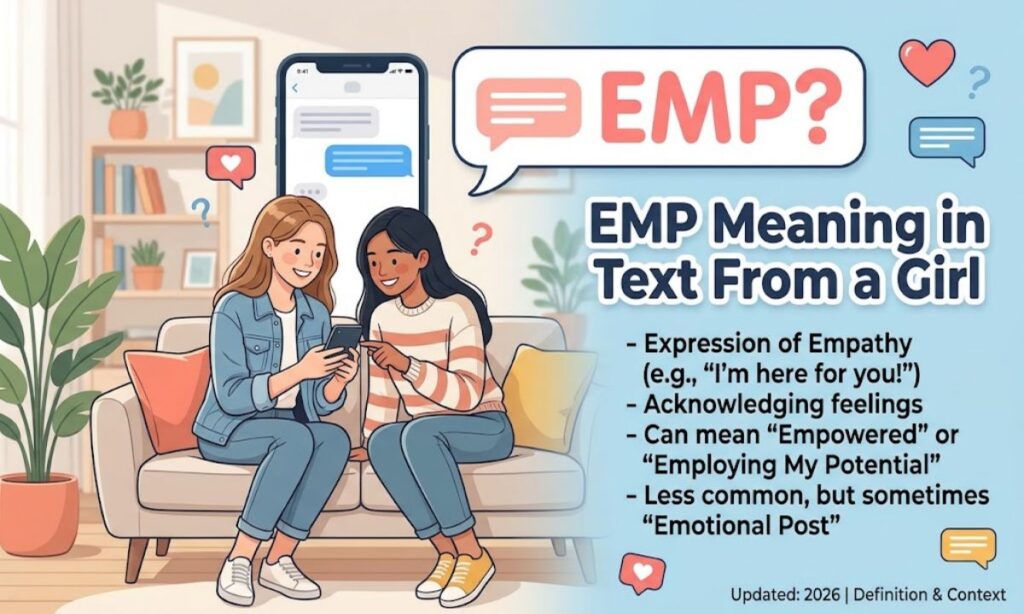
In most casual chats, EMP Meaning is a shortened form of “empathy” or “empathetic.” When someone sends it, she is usually saying she understands your feelings, she feels with you, or she wants to show care without writing a long message.
Simple meaning
The simplest answer is this: EMP Meaning stands for empathy. It signals emotional understanding. If you told her about a rough day and she replied “EMP,” she is telling you she gets it and she is on your side. Think of it as a tiny, typed version of a supportive nod.
Common ways it may be used
People use the abbreviation in a few predictable ways:
- To show support after someone shares bad news
- To say “I feel you” when a friend vents
- To react to a sad, stressful, or vulnerable story
- To describe someone as an empathetic person (“she is so EMP”)
- To mark a conversation as emotional, not casual
Because there is no universal dictionary entry, context always decides the final meaning.
Example messages
Here are a few short examples of how it might appear:
- “Missed my train and failed my quiz today.” / “EMP, that sounds exhausting.”
- “My dog is not eating well.” / “EMP. I hope he feels better soon.”
- “Just needed to say that out loud.” / “EMP. I am here.”
In each case, the abbreviation works as a quick emotional reaction.
Origin & Background of EMP Meaning

To understand the EMP meaning in text from a girl, it helps to look at where the term comes from and why it feels natural in modern messaging.
The linguistic origin
The root is the word “empathy,” which comes from the Greek word empatheia, meaning “feeling into.” The first three letters, E-M-P, are a natural clipping. English speakers have always shortened long words (“information” became “info,” “application” became “app”), so trimming “empathy” down to three letters follows a familiar pattern.
How EMP entered texting culture
Texting rewards speed. Early SMS limits and later fast-paced chat apps pushed people toward short forms such as LOL, BRB, and IDK. As conversations about mental health, kindness, and emotional awareness became more open, people needed quick ways to express care. Clipped emotional words like “EMP” fit that need, especially among younger users who prefer brevity over formality.
Social media influence
Social platforms accelerate slang. A phrase used in a comment section or a short video can reach millions of people in days. Posts about self-care, “empath” personality traits, and emotional intelligence made empathy a popular topic, and the shortened form followed. Still, it remains informal and is not yet as widely recognized as classic abbreviations, which is why confusion is common.
Real-Life Conversations (How Girls Actually Use EMP)
Examples make meaning clearer. Below are three realistic chat styles.
WhatsApp conversation
Her: I did not get the internship.
You: Honestly I feel terrible, I studied so hard for it.
Her: EMP. You worked so hard, and it shows.
Here, the abbreviation opens a supportive reply. It shows she recognizes your disappointment before offering encouragement.
Instagram DM conversation
Him: My grandma is in the hospital this week.
Her: EMP 💛 thinking of you and your family.
On Instagram, the term is often paired with an emoji. The emoji softens the tone and makes the care feel more personal.
Text message conversation
Her: Long day. Boss yelled at everyone.
You: Ugh, same thing happened to me last month.
Her: EMP fr. That is the worst.
In this case, she uses it to say she relates to the situation. “Fr” (for real) adds emphasis.
Emotional & Psychological EMP Meaning
Short words can carry heavy emotional weight. Understanding the psychology behind the abbreviation helps you read the message correctly.
What it can reflect about the sender
A girl who uses EMP Meaning often values emotional connection. She may be attentive, sensitive to other people’s moods, and comfortable showing care in writing. It does not automatically mean she has romantic feelings. More often, it reflects a supportive personality or a close friendship.
Why people connect with empathy language
Humans are social creatures who want to feel seen. When someone acknowledges our feelings, even in one word, our stress eases. Empathy language builds trust quickly because it tells the listener, “You are not alone.” That is why abbreviations tied to care spread easily among friends and online communities.
Psychological impact
Research in psychology has long linked feeling understood to lower stress and stronger relationships. A small message like this will not replace a real conversation, but it can open the door to one. On the other hand, if empathy is expressed only in abbreviations and never in deeper talk, the recipient may feel the support is shallow. The best use pairs the short form with a follow-up sentence.
Usage in Different Contexts
The same three letters can feel warm, flat, or confusing depending on the setting.
Social media
On platforms like Instagram, TikTok, and X, it appears in comments and replies, usually under emotional posts. People use it to show quick support without writing a paragraph. It works well in public spaces where long messages feel excessive.
Friends & relationships
Among friends, it reads as affectionate shorthand. In a relationship, it can signal that she is listening. However, partners usually expect more than three letters during serious conversations. If a topic matters, a fuller reply shows deeper care.
Work or professional settings
In professional chats, abbreviations can be risky. Colleagues may not recognize EMP and may read it as something unrelated, such as “employee” or “employment.” In workplace messaging, writing out “I understand how stressful that must be” is safer and clearer.
Casual vs serious tone
Casual tone: a quick “EMP lol” after a minor complaint about traffic. Serious tone: “EMP. I am so sorry you are going through this.” The words around it, the punctuation, and the emoji tell you which tone she intends. A period after it often feels more sincere than an exclamation mark.
Common Misunderstandings
Because the abbreviation is not universal, people often misread it. Here are the most frequent errors.
Mistake #1: Thinking it means “employee”
In business writing, EMP Meaning can be a short form for “employee” in forms and spreadsheets. In a personal chat from a girl, though, that meaning almost never applies. Unless you are talking about work records, assume the emotional meaning first.
Mistake #2: Assuming it’s sarcasm
Some readers see short replies as cold or sarcastic. In reality, the term is usually sincere. Sarcasm normally comes with clear signals such as exaggerated punctuation, mocking emojis, or an obviously ironic situation. If none of those are present, take it at face value.
Mistake #3: Using it in the wrong context
Sending EMP Meaning in reply to good news, a joke, or a formal email can confuse people. The abbreviation belongs with feelings, especially difficult ones. When the context does not match, the message may look careless or even insensitive.
Comparison Table
The table below shows how this abbreviation compares with similar ways of expressing care.
| Expression | Tone | Typical Context | Level of Emotion |
| EMP | Casual, warm | Friends, social media, DMs | Light to medium |
| “I understand” | Neutral, clear | Any setting | Medium |
| “I feel for you” | Personal, sincere | Close relationships | Medium to high |
| “Sending hugs” | Affectionate | Friends, family | Medium |
| A phone call | Deep, direct | Serious situations | High |
Key Insight
The abbreviation sits at the lighter end of the emotional scale. It is perfect for quick, kind reactions, but it should not replace a deeper conversation when someone is truly struggling.
Variations and Related Expressions
People express the same feeling in many different ways. These related terms help you understand the wider picture.
1. Empathy
The full word. It means sharing and understanding another person’s feelings. It is the root of the abbreviation and the safest form to use in formal writing.
2. Emotional Support
This refers to comfort, encouragement, and attention given during hard times. A message like EMP is often a tiny piece of emotional support.
3. Compassion
Compassion goes one step beyond empathy. It includes the wish to help. Someone showing compassion may offer to listen, assist, or check in later.
4. Emotional Intelligence
This is the ability to recognize, understand, and manage emotions, both your own and other people’s. Girls who use empathy shorthand often show high emotional intelligence in conversations.
5. Sympathy
Sympathy means feeling sorrow for someone’s situation. It is slightly more distant than empathy, since you acknowledge the pain without necessarily sharing it.
6. Supportive Response
A supportive response is any reply that encourages and reassures. It can be a word, an emoji, or a long message. EMP Meaning often functions as the shortest version.
7. Validation
Validation tells someone their feelings make sense. Phrases such as “that is completely understandable” validate emotions and often accompany empathy shorthand.
8. Understanding
Simple understanding is the base of every caring reply. Saying “I get it” or “I see what you mean” builds a bridge between two people.
9. Caring Reaction
A caring reaction might be a heart emoji, a hug sticker, or a quick “are you okay?” These reactions work alongside the abbreviation to create a warm tone.
10. Comfort Message
A comfort message is written specifically to soothe. It might include kind words, a gentle joke, or an offer to talk. When EMP Meaning leads such a message, it signals the start of comfort.
How to Respond When Someone Uses EMP
Your reply depends on your relationship and the topic. Here are options for different situations.
Casual replies
- “Thanks, I really needed that.”
- “Appreciate you, honestly.”
- “Yeah, it has been a lot lately.”
These keep the mood light and show gratitude without making the moment heavy.
Funny replies
- “Thanks, my feelings feel officially processed.”
- “Three letters and I already feel better.”
- “Empathy received. Coffee next?”
Humor works best when the situation is mild. If the topic is serious, skip the jokes.
Mature or confident replies
- “Thank you for understanding. It means a lot, and I am working through it.”
- “I appreciate the support. Let me know if you ever need the same.”
These show emotional maturity and return the kindness without drama.
Respectful replies
- “Thank you for your kindness.”
- “I appreciate you taking the time to say that.”
Use these in new friendships, group chats, or any situation where you want to stay polite and measured.
Regional & Cultural Usage
The EMP meaning in text from a girl can feel different depending on where she lives and what culture shapes her communication style.
Western culture
In countries such as the United States, the United Kingdom, and Canada, open emotional language is common among young people. Abbreviations tied to empathy and mental health appear frequently in friend groups and online communities. Directly naming feelings is generally accepted and encouraged.
Asian culture
In many Asian communities, emotional expression can be more reserved, especially between people who are not very close. A short abbreviation may feel safer than a long emotional paragraph, so it can serve as a polite way to show care. English slang is also mixed with local languages, which can change how the term is read.
Middle Eastern culture
In Middle Eastern settings, warmth and hospitality are central to communication, and messages often include blessings or prayers. A girl might combine the abbreviation with a kind phrase in Arabic or another language. The abbreviation itself is less common, so a longer, more personal message is usually expected for serious matters.
Global internet usage
Online, language boundaries blur. Users on global platforms borrow slang from each other constantly. Even so, there is no single official definition, so meaning always comes from context. When in doubt, politely asking what someone means is far better than guessing.
Frequently Asked Questions
What does EMP mean when a girl texts it?
In most casual conversations, it is short for empathy. She is showing understanding, support, or care for what you shared.
Does EMP mean she likes me?
Not necessarily. It signals kindness and emotional awareness, which can appear in friendships, family chats, and romantic interest alike. Look at her overall behavior, not one abbreviation.
Is EMP a common texting abbreviation?
It is not as widely known as LOL or OMG. Its use is growing in certain communities, but many people still need an explanation.
Can EMP have another meaning?
Yes. Outside of chats, EMP Meaning can stand for electromagnetic pulse, employee, or other terms depending on the field. In an emotional conversation with a girl, empathy is by far the most likely meaning.
Should I use EMP in professional messages?
It is better to avoid it. Colleagues may not understand it. Use a full sentence to express understanding instead.
How do I reply if I am unsure what she means?
Ask casually: “Do you mean empathy? I just want to be sure I understand!” Most people appreciate the honesty and will clarify happily.
Is EMP Meaning a sign of sarcasm?
Rarely. Unless there are clear sarcastic signals, it is meant sincerely.
Conclusion
The EMP meaning in text from a girl is, in most cases, simple and kind: it stands for empathy, and it is her quick way of saying she understands and cares. Its roots trace back to the Greek idea of “feeling into” another person’s experience, and modern texting culture has shrunk that idea into three quick letters. Context is everything. Check the topic, the tone, the emoji, and your relationship before deciding what she means, and remember that the abbreviation can also stand for unrelated things such as “employee” in work settings.
When you receive it, respond with warmth, whether that is a thank-you, a gentle joke, or an honest update on how you are feeling. When you send it, pair it with a real sentence if the moment is serious. Small words can open big conversations, and understanding how to read and answer them makes your messages more thoughtful, your friendships stronger, and your communication clearer in 2026 and beyond.

Noah is a passionate content writer and language enthusiast who enjoys making difficult words, phrases, and text meanings easy to understand. She creates clear, simple, and useful articles with practical examples to help readers improve their vocabulary and everyday language skills.