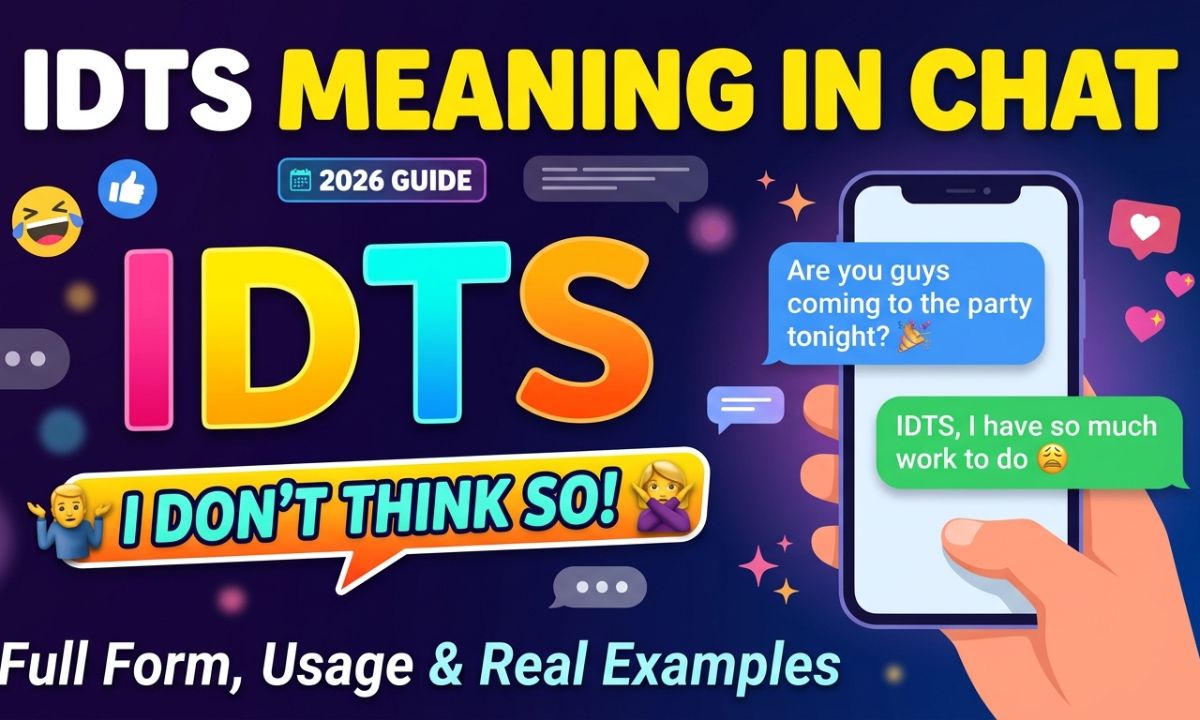
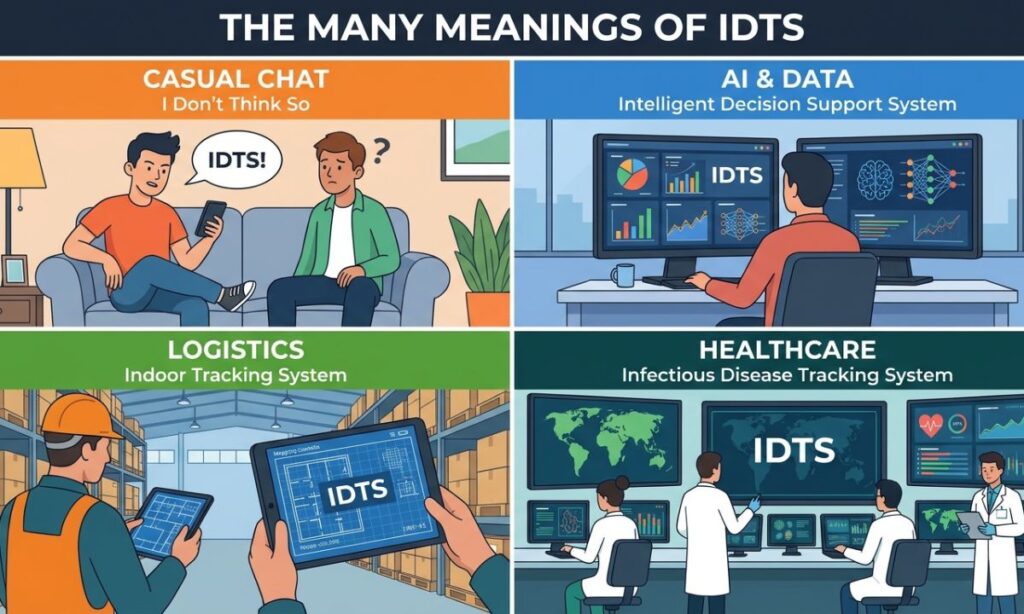
In online conversations, IDTS stands for “I Don’t Think So,” a quick, polite way to disagree or decline. Understanding the IDTS meaning in chat helps you decode messages across WhatsApp, Instagram, Snapchat, Discord, TikTok, and X (formerly Twitter) without confusion. Popularized by Gen Z and millennial texters, this internet abbreviation sits alongside IDK, IDC, and IMO as a staple of casual digital slang. Whether a friend replies “idts, I’m busy tonight” or a group chat debates plans, knowing the IDTS full form, tone, and context keeps your replies sharp and natural. This guide explains usage, real examples, and common mix-ups, so you can text confidently in 2026.
IDTS Meaning in Chat – Quick Meaning
Simple Definition
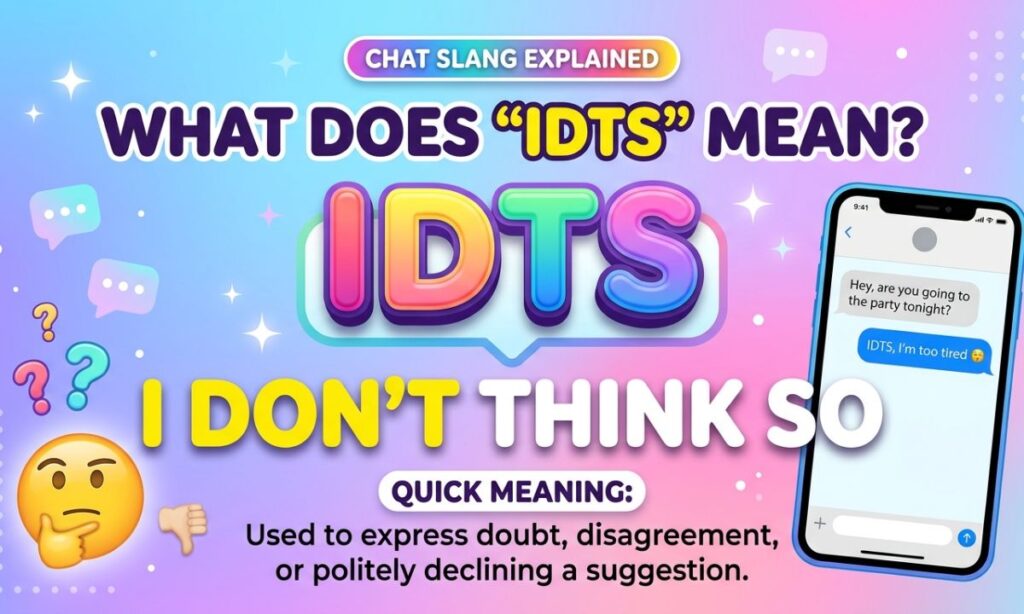
IDTS Meaning stands for “I don’t think so,” a short way to disagree without sounding too strong.
Quick answer:
IDTS means “I don’t think so.” People use it in texts and comments to show doubt, mild disagreement or a soft “no.”
| Detail | Info |
| Full Form | I Don’t Think So |
| Type | Internet slang / text abbreviation |
| Tone | Casual, doubtful, sometimes playful |
| Best Used In | Texts, DMs, comments, group chats |
| Avoid In | Formal emails, reports, job messages |
Examples
- “Will it rain today?” → “IDTS, the sky looks clear.”
- “Is she coming to the party?” → “IDTS.”
- “Did he finish the work?” → “IDTS 😂.”
The term grew from the habit of shortening common phrases in texting. “I don’t know” became IDK, and “I don’t care” became IDC. “I don’t think so” followed the same pattern.
Sources describe it as a compressed form of the phrase that expresses doubt or disagreement. There is no single known inventor. It spread through everyday use on messaging apps and social media.
Real-Life Conversations of IDTS Meaning
WhatsApp Conversation
Ali: Are you free tonight?
Sara: IDTS, I have work till late.
Sara gives a polite, soft refusal.
Instagram DM
Mia: Do you think he’ll text back?
Zoe: idts 😅 he’s been quiet all week.
The emoji softens the message.
TikTok Comments
Comment: This team will win the cup.
Reply: IDTS 😂
Here the tone is playful and a bit teasing.
Text Message
Dad: Did you take the keys?
Me: IDTS, check the table.
The abbreviation signals “probably not, but I’m not sure.”
Group Chat
Hamza: Is the shop open on Sunday?
Bilal: IDTS.
Hamza: I’ll check online.
Others see the doubt and know to verify.
Emotional & Psychological IDTS Meaning
IDTS Meaning often carries a gentle form of doubt. The speaker isn’t saying a flat “no.” They are leaving room for being wrong.
Writers on the topic note that it points to a tentative negation, not a firm one. That is why people reach for it when they want to avoid conflict.
It can also show:
- Politeness: a soft way to decline.
- Skepticism: “I doubt that’s true.”
- Humor: a teasing reaction to a bold claim.
- Distance: a short reply that ends a topic.
Because there’s no tone of voice in text, emojis and punctuation matter. One guide notes that a playful emoji makes it sound light, while a plain period can make it feel more serious.
Usage in Different Contexts of IDTS Meaning
Social Media
On social media, IDTS Meaning shows up in comments, replies and story responses. It is a quick way to push back on a take. Short, casual and often paired with an emoji.
Friends & Relationships
Among friends it sounds natural. In a close relationship, a plain “IDTS” to a serious question can feel cold. Add a few words to keep it warm.
- Cold: “IDTS.”
- Warmer: “IDTS, but let me check and tell you.”
Text Messages
In texts it works as a speedy answer to yes/no questions. It saves typing and keeps the chat moving.
Work or Professional Settings
Sources point out that a full phrase suits a professional email better than the abbreviation. In a quick chat with a close coworker it may be fine. In emails, reports or client messages, write “I don’t think so.”
Casual vs. Serious Tone
| Style | Example | Feels Like |
| Casual | “IDTS 😂” | Playful, light |
| Neutral | “idts, not sure” | Honest doubt |
| Serious | “IDTS.” | Firm, cooler |
| Formal | “I don’t think so.” | Professional |
Common Misunderstandings of IDTS Meaning
Mistake 1: Assuming It Means “No”
IDTS is softer than “no.” The speaker may be unsure and open to correction.
Mistake 2: Thinking It’s Rude
It isn’t rude by default. Tone depends on context, emoji and the relationship. A cold, lone “IDTS.” can still sting, though.
Mistake 3: Using It Professionally
Using slang in formal settings can look careless. Keep it for casual chats.
Mistake 4: Assuming Everyone Knows It
Not everyone reads slang. Older relatives or non-native English speakers may not know it. If your audience is mixed, spell it out.
Comparison Table IDTS Meaning
| Phrase | Strength of “No” | Tone |
| IDTS | Soft | Casual, doubtful |
| IDK | None (unsure) | Neutral |
| Nope | Firm | Blunt, casual |
| No | Firm | Direct |
| I disagree | Firm | Formal |
Key Insight
IDTS sits between “I’m not sure” and “no.” It tells the reader you lean toward no but aren’t certain.
Variations and Related Types
These are common patterns where people pair the abbreviation with other slang:
1. IDTS TBH
Means “I don’t think so, to be honest.” It adds honesty and a gentle tone.
2. IDTS LOL
Softens the reply with humor. Often used when teasing.
3. IDTS FR
Means “I don’t think so, for real.” It shows you mean it.
4. IDTS Yet
Suggests it hasn’t happened yet but may later.
5. Probably IDTS
A very soft “no.” The speaker is quite unsure.
6. Strong IDTS
Said with emphasis, often in caps: “IDTS!” It feels more firm.
7. IDTS Either
Used to agree with a negative: “I don’t think so either.”
8. IDTS Anymore
Shows change over time: “I don’t think so anymore.”
9. IDTS Honestly
A calm, sincere version of the same doubt.
10. IDTS But Maybe
Shows mixed feelings. The speaker leaves a door open.
How to Respond When Someone Uses It
Casual Replies
- “Okay, no worries.”
- “Fair enough.”
- “Cool, I’ll check.”
Funny Replies
- “Ouch 😂 okay.”
- “Was that a no or a maybe?”
- “I’ll take that as a ‘we’ll see.'”
Mature & Confident Replies
- “Got it. Thanks for being honest.”
- “Understood. Let me know if that changes.”
- “No problem. I’ll plan around it.”
Private or Respectful Replies
If the topic is sensitive, move to a call or a direct message:
- “Can we talk about it later?”
- “I’d like to understand. Can I ask a bit more?”
Regional & Cultural Usage of IDTS Meaning
Western Culture
It is most common in English-speaking countries such as the US, UK and Canada. Young adults and teens use it often in texting.
Asian Culture
In parts of Asia, many people use English slang in chats and comments. Users often mix it with local languages. They may use it for politeness, since it softens a “no.”
Middle Eastern Culture
Bilingual users often mix English abbreviations with Arabic or other languages. IDTS can appear in casual chats, but it’s less common in formal talk.
Global Internet Usage
I found no reliable data on exact regional use. What is clear is that it tracks English-language social media. Meaning stays the same, but how blunt it feels changes by culture and relationship.
One more note: in a medical setting, IDTS can stand for infectious diseases transition service. In chats, it almost always means “I don’t think so.”
Frequently Asked Questions
What does IDTS mean in text?
It means “I don’t think so.” It shows doubt or soft disagreement.
What is the full form of IDTS?
The full form is “I Don’t Think So.”
Is IDTS rude?
Not by default. Tone depends on emojis, punctuation and the relationship.
Is IDTS a yes or a no?
It leans toward no. It is softer and less final than a plain “no.”
Can I use IDTS in a work email?
No. Use the full phrase in formal or professional messages.
Is IDTS the same as IDK?
No. IDK means “I don’t know,” while IDTS means “I don’t think so.”
Does IDTS mean anything else?
In medicine it can mean infectious diseases transition service. In chats, it means “I don’t think so.”
How do I reply to IDTS?
Keep it simple: “Okay, no problem,” or ask a short follow-up.
Is IDTS used on TikTok and Instagram?
Yes. It shows up in comments, replies and DMs.
Conclusion
IDTS stands for “I don’t think so.” It is a casual text abbreviation used on WhatsApp, Instagram, TikTok and in group chats to show doubt or a soft “no.” It grew from the habit of shortening phrases like IDK and IDC, and its tone changes with emojis and punctuation.
The article covers real chat examples, common mistakes such as treating it as a rude “no” or using it at work, ten variations like IDTS TBH, and reply ideas for casual, funny and respectful moments. It also notes that the meaning stays the same worldwide, while bluntness varies by culture and relationship.

Noah is a passionate content writer and language enthusiast who enjoys making difficult words, phrases, and text meanings easy to understand. She creates clear, simple, and useful articles with practical examples to help readers improve their vocabulary and everyday language skills.