Scroll through Instagram comments, TikTok replies, or a group chat, and you will probably see “SFS” and wonder what it means. This guide explains the SFS meaning in text, where it came from, how people use it, and how to reply. Whether you are a casual user or a creator trying to grow, it covers what you need.
SFS Meaning in Text – Quick Meaning

In most online conversations, SFS stands for “shoutout for shoutout.” It is a trade: you promote my account, and I promote yours. A shoutout is a public mention, such as a story post, a tagged photo, a video recommendation, or a comment that points followers to someone else’s profile.
The SFS meaning in text is built on reciprocity. Both people agree to give each other exposure, usually in the hope of gaining followers, likes, and views. You will see it mostly on Instagram, TikTok, Snapchat, and YouTube.
Quick breakdown
- Full form: Shoutout for shoutout
- Main platforms: Instagram, TikTok, Snapchat, YouTube, WhatsApp status
- Tone: Casual, friendly, and promotional
- Purpose: Mutual promotion and audience growth
- Typical use: A comment, DM, or story caption such as “SFS?” or “Anyone up for SFS?”
Context sometimes changes the meaning. In rare cases, SFS can mean “spam for spam” or “smash for smash,” and in a non-social context it may even stand for something unrelated, like “science fiction story.” On social media, though, “shoutout for shoutout” is by far the most common meaning.
Origin and Background of SFS Meaning
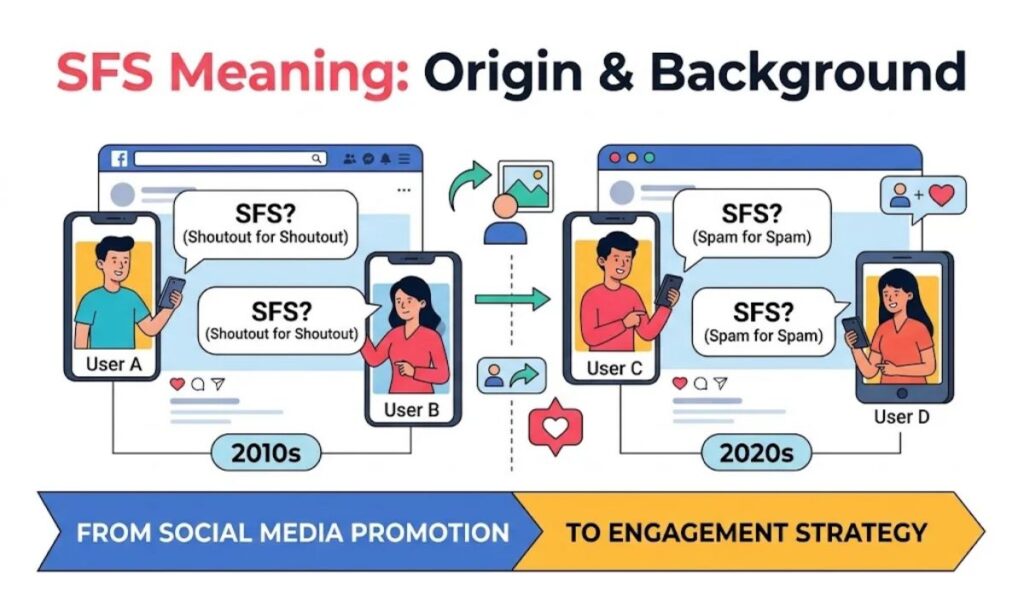
“Shoutout” is older than social media. It began as radio and music culture slang, where DJs and rappers thanked or greeted people by name on air. When social platforms arrived, the habit moved online, and a “shoutout” became any public mention that sends attention to someone else.
The “for” format came from the early Instagram growth era, around 2012 to 2016. Small creators had no advertising budget and needed an organic way to reach new audiences. People started proposing swaps, and shorthand followed. “L4L” meant “like for like,” “F4F” meant “follow for follow,” and “S4S” and “SFS” meant “shoutout for shoutout.” Typing the full phrase in comments was slow, so abbreviations spread quickly.
By 2026 the term has outlived many other growth slang terms. Algorithms now punish obvious follow-trading, but SFS survives because it feels more personal and more community-based. A shoutout usually includes a recommendation, which makes it feel more genuine than a bare follow swap. That is why the SFS meaning in text is still widely recognized across age groups and regions.
Real-Life Conversations Using SFS
Examples show how the term works in practice. Here are three typical conversations.
WhatsApp Conversation
Sara: Hey, I just started my baking page. Want to do an SFS?
Mina: Sure! Send me your handle and I’ll post you on my status tonight.
Sara: Perfect, I’ll do yours on mine in an hour 🎂
Mina: Deal. Tag me so people can find me!
Here the exchange is private and friendly. Both people agree on timing and tagging, and the trade feels fair.
Instagram DM Conversation
Creator A: Love your travel reels! SFS on stories today?
Creator B: Yes! How many followers do you have?
Creator A: About 4k. You?
Creator B: Around 5k. Close enough, let’s do it. I’ll post at 6 pm.
Creators often compare follower counts before agreeing. A trade works best when audiences are similar in size and interest.
TikTok Comment Conversation
User 1: Just posted my first dance video, SFS anyone? 💃
User 2: Followed you! SFS, check my page.
User 3: Cute video! Do you do SFS with beauty creators too?
TikTok comments are public and fast. Many users post “SFS” under popular videos to attract trade partners, although others see this as spam.
Emotional and Psychological of SFS Meaning

The SFS meaning in text goes beyond a marketing trick. It reflects real social and emotional drives.
Reciprocity
People feel a strong pull to return favors. When someone promotes you, you feel inclined to promote them back. SFS turns that instinct into an explicit agreement, which makes it feel safe and fair.
Community
Small creators often feel invisible. An SFS trade connects them to peers who understand the struggle. Many lasting online friendships start with a simple swap, and groups of creators sometimes form around regular shoutout exchanges.
Validation
Being recommended publicly feels good. A shoutout tells you someone found your work worth sharing, and that boosts confidence, especially for new creators who have not yet built a loyal audience.
Ambition
SFS also reflects ambition. People who ask for trades want to grow, reach more viewers, and maybe turn a hobby into income. The abbreviation carries a quiet message: “I’m working on this, and I’m willing to support others too.”
Using SFS in Different Contexts
The same three letters can feel different depending on who says them and where.
SFS on Social Media
This is the main home of the term. On Instagram, it often means posting each other’s profile in stories. On TikTok, it can mean duetting, stitching, or recommending a video. On YouTube, creators may mention each other’s channels at the end of a video. Always check which format the other person has in mind, since “shoutout” can mean very different amounts of effort.
SFS Between Friends
Among friends, SFS is playful and low pressure. You might post a friend’s new business page on your story and ask for the same in return. Because trust already exists, there is little worry about fairness, and the trade often happens without much negotiation.
SFS in Relationships
In romantic relationships, SFS is rare, but couples who run creative or business accounts together may use it. It can also appear as a joke, such as “Post me on your story and I’ll post you on mine.” Keep the tone light, because using trades as a test of affection can create unnecessary tension.
SFS at Work or in Professional Settings
In professional settings, the abbreviation should be used carefully. Freelancers, small business owners, and influencers do trade promotions, but formal emails should spell out “shoutout exchange” or “cross-promotion.” SFS works fine in casual team chats among social media managers, but it can sound unprofessional with clients or executives who do not know the slang.
Common Misunderstandings About SFS Meaning
Even popular slang gets misread. Here are the most frequent errors.
Mistake 1: Thinking SFS always means friendship
An SFS trade is a transaction, not a promise of friendship. Many people agree to a swap and never speak again. Treat it as a mutually beneficial agreement, and let real friendships develop naturally if they do.
Mistake 2: Assuming a shoutout is guaranteed
Some users post “SFS” in comments and expect strangers to follow through. A reply is not a commitment until both sides confirm details. Agree on timing, format, and tags, and consider screenshots as proof once each person has posted.
Mistake 3: Using SFS in formal communication
Because the SFS meaning in text is casual, using it in formal emails or business proposals can confuse recipients. Write the full phrase or choose a more professional term instead.
Mistake 4: Ignoring context
Not every “SFS” means shoutout for shoutout. If the conversation is about gaming, stories, or something else entirely, the abbreviation may stand for another phrase. When in doubt, ask. A quick “Do you mean shoutout for shoutout?” prevents embarrassing mistakes.
SFS Compared With Similar Terms
SFS belongs to a family of “for” abbreviations. Here is how it compares.
| Term | Meaning | What you trade |
| SFS / S4S | Shoutout for shoutout | Public promotion |
| F4F | Follow for follow | Follows |
| L4L | Like for like | Likes |
| C4C | Comment for comment | Comments |
| S4S (YouTube) | Sub for sub | Subscriptions |
| TFT | Trade for trade | Items or favors |
Key Insight
The main difference is effort and visibility. A follow or like takes a second and is easy to ignore. A shoutout puts your recommendation in front of an entire audience, which means it carries more trust and, if done well, brings more engaged followers. That makes the SFS meaning in text more valuable to creators than simple engagement swaps.
Variations and Related Types of SFS
SFS comes in many forms depending on the platform and goal.
1. Story SFS
The most common type. Each person posts the other’s profile on their Instagram or Facebook story, usually for 24 hours.
2. Post SFS
A more permanent version, where one person features the other in a feed post or tagged photo. It takes more commitment and usually requires more trust.
3. Reel SFS
Creators mention each other in short videos or include each other’s handles in captions. Reels reach non-followers, so this form can drive real growth.
4. TikTok SFS
Users recommend each other through video replies, duets, stitches, or pinned comments. Because the algorithm favors interaction, TikTok SFS often spreads faster than other formats.
5. Small Creator SFS
Accounts with fewer than 5,000 followers often trade shoutouts to build early momentum. These trades are usually friendly and informal.
6. Business SFS
Local shops, cafes, and online stores swap promotions with complementary brands. A bakery might trade with a coffee roaster, for example. This form works best when audiences overlap but the businesses do not compete.
7. Niche SFS
Creators in the same niche, such as fitness, gaming, or fashion, trade with each other so the audience is already interested. Niche trades usually produce better follower quality.
8. Follow-for-SFS
A hybrid in which someone says “follow me and I’ll do an SFS.” It combines follow trading with shoutouts but can feel pushy if overused.
9. Engagement SFS
Participants also agree to like and comment on each other’s recent posts, which signals to the algorithm that the content is worth showing.
10. Group SFS
A group of creators, often in a chat or “engagement pod,” shares each other’s content on a schedule. This can create strong reach but requires coordination and honesty.
How to Respond When Someone Uses SFS
Your reply depends on your goal and your relationship with the person. Here are some options.
Casual Replies
- “Sure! Send me your handle.”
- “SFS sounds good. When do you want to post?”
- “Yes, let’s do it. I’ll tag you.”
Funny Replies
- “Only if you promise to make me look as good as I make you look 😄”
- “SFS accepted. May our follower counts rise together.”
- “I’ll shout, you shout, we all shout for growth!”
Mature and Confident Replies
- “I’m open to an SFS if our audiences match. Could you share your follower count and niche?”
- “Happy to trade. Let’s agree on the format and timing first.”
- “I prefer SFS with accounts in the same niche. What’s your content about?”
Private or Respectful Replies
If you want to decline politely, try:
- “Thanks for asking, but I’m not doing SFS trades right now.”
- “I appreciate the offer, though my audience wouldn’t be the right fit for your page.”
- “I’m keeping my feed focused on my own content at the moment, but I wish you the best!”
A polite decline protects your reputation and keeps the door open for future collaboration.
Regional and Cultural Usage of SFS
Slang changes with culture, and the SFS meaning in text carries slightly different flavors around the world.
Western Culture
In the United States, the United Kingdom, and Australia, SFS is widely understood among teenagers and young creators. It is treated as a normal growth tactic, though some influencers now view it as outdated compared with brand deals and collaborations.
Asian Culture
In countries such as India, Pakistan, the Philippines, and Indonesia, shoutout trades are very popular, especially among small business owners and student creators. Story swaps are common on Instagram and WhatsApp status, and many local communities run organized shoutout groups.
Middle Eastern Culture
In Middle Eastern markets, shoutouts often blend with community recommendations. Users value trust and personal connection, so SFS trades may happen between people who already know each other. Language mixing is common, with Arabic and English phrases appearing together in captions.
Global Internet Usage
Across the world, the abbreviation spreads through English-language social media, so even non-native speakers recognize it. Because platforms are global, a creator in Lahore can trade with one in London in seconds, which keeps the term alive and evolving.
Frequently Asked Questions
What does SFS meaning in text?
In most conversations, SFS means “shoutout for shoutout,” an agreement to promote each other’s accounts.
Is SFS the same as S4S?
Yes. Both abbreviations stand for shoutout for shoutout. S4S uses the number “4” to replace the word “for.”
Is SFS allowed on Instagram and TikTok?
Yes, normal shoutouts are allowed. However, mass spamming comments or using fake accounts can violate platform rules and lead to restrictions.
Does SFS actually help you gain followers?
It can, especially when you trade with accounts in your niche and of similar size. Random trades with unrelated audiences usually bring little real engagement.
Is it safe to do SFS with strangers?
Be careful. Check that the account looks genuine, has real engagement, and posts appropriate content. Never share passwords or personal details, and avoid anyone who asks for money to “guarantee” a trade.
Can SFS mean something else?
Occasionally. Depending on the context, it may mean “spam for spam,” “smash for smash,” or an unrelated acronym. Look at the conversation to confirm.
How should I write SFS in a message?
Keep it short and friendly, such as “SFS? I’ll post you on my story today.” Add your handle so the other person can find you easily.
Is SFS still popular in 2026?
Yes. While brand partnerships and collaborations have grown, SFS remains a simple, free way for small creators and businesses to get noticed.
Conclusion
Understanding the SFS meaning in text helps you read online conversations, join creator communities, and make smart decisions about promotion. At its core, SFS is a simple agreement: I support you, you support me. It grows out of reciprocity, community, validation, and ambition, and it shows up in everything from friendly WhatsApp chats to organized group trades on TikTok.
To use it well, match your trades to your niche and audience size, agree on the details before posting, and keep your tone friendly. Avoid the common mistakes: do not assume a promise is guaranteed, do not use the slang in formal settings, and always check the context. If you do not want to participate, decline politely.
Slang changes quickly, but the idea behind SFS is lasting. Supporting others while building your own presence is a healthy way to grow online, and as long as people share content, they will keep trading shoutouts.

Noah is a passionate content writer and language enthusiast who enjoys making difficult words, phrases, and text meanings easy to understand. She creates clear, simple, and useful articles with practical examples to help readers improve their vocabulary and everyday language skills.