You have probably seen NGL pop up in a chat, a comment, or a story reply and wondered what it means. It looks short and simple, yet people use it in many ways. This guide explains the NGL meaning in text, where it came from, and how to use it without sounding awkward. You will also find real chat examples, a comparison table, related slang, and answers to common questions.
NGL Meaning – Quick Definition

NGL stands for “not gonna lie.” People type it before they say something honest, surprising, or a little bold. It works like a soft warning that a true opinion is coming. It is short, casual, and very common on social media and in private chats.
Quick Meaning:
NGL = Not Gonna Lie
It tells the reader that the speaker is being honest. The honest part can be a compliment, a confession, a complaint, or a plain opinion. The tone depends on the words that follow.
Examples:
- “NGL, that song is stuck in my head all day.”
- “NGL, I forgot we had a test today.”
- “NGL, you look great in that photo.”
- “NGL, I was nervous before the interview.”
- “That movie was long, NGL.”
You can place NGL at the start or at the end of a sentence. Both ways are normal. At the start it prepares the reader. At the end it adds a light, honest touch.
Origin and Background of NGL Meaning

The phrase “not gonna lie” existed in spoken English long before texting. People said it out loud to show they were being direct. When texting and online chat grew, people shortened long phrases to save time. “Not gonna lie” became NGL, the same way “laugh out loud” became LOL.
Early chat rooms and forums used many such short forms. Later, mobile messaging made them even more popular. Fast typing on small screens pushed people toward short words. NGL fit well because it was only three letters and easy to remember.
Social media then spread it further. Short videos, captions, and comments gave the slang a huge audience. Young users used it daily, and soon people of many ages began to understand it. By 2026, NGL is one of the most recognized slang terms online. You can see it in captions, replies, group chats, and even casual emails between friends.
The term also gained attention through anonymous message apps that carried the same letters in their name. These apps invited people to send honest, anonymous notes. That made the idea of honesty and NGL even more connected in the public mind.
Real-Life Conversations
Examples make slang easier to learn. Here are a few common situations where NGL appears.
WhatsApp Conversation
Sara: Did you watch the match last night?
Ali: Yes. NGL, I fell asleep in the second half.
Sara: Haha, same. It got boring.
Ali: NGL, I only stayed for the highlights.
Here NGL adds a friendly, honest tone. Nobody is offended. It makes the talk feel relaxed.
Instagram DM
Maya: I saw your new haircut. NGL, it suits you a lot.
Zoe: Thank you! I was unsure about it.
Maya: Trust me, it looks amazing.
In this case NGL softens a compliment and makes it sound sincere.
TikTok Comments
- “NGL this recipe saved my dinner.”
- “NGL I watched this three times.”
- “This trend is fun, NGL, but I can’t dance.”
On TikTok, NGL shows up in many comments. People use it to share small honest reactions quickly.
Text Messages
Ben: Are you coming to the party?
Chris: NGL, I’m too tired tonight.
Ben: No worries, rest well.
NGL here makes a refusal feel gentle and truthful instead of cold.
The Emotional and Psychological NGL Meaning
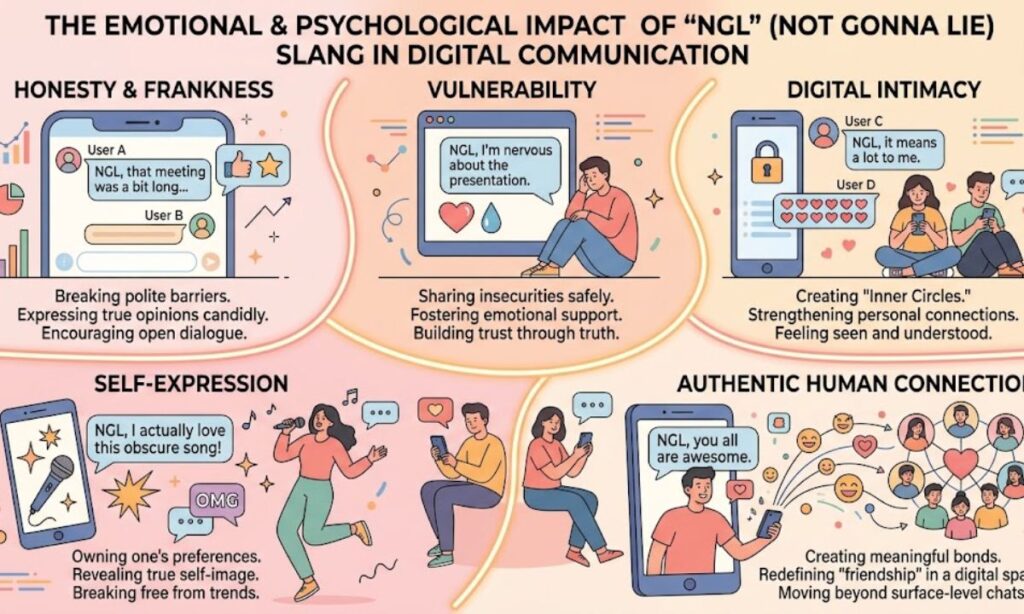
NGL looks like a tiny abbreviation, but it carries feeling. People choose it for reasons beyond saving time.
Vulnerability
Saying something honest can feel risky. NGL acts as a cushion. It lets a person share a real feeling without making it too heavy. For example, “NGL, I miss you” feels softer than a very formal sentence. The speaker opens up, but in a light way.
Surprise
NGL often signals that the speaker did not expect something. “NGL, I didn’t think this would work” shows surprise. The reader understands the speaker is admitting something unexpected.
Trust
When you use NGL with someone, you show you feel safe enough to be honest. Close friends use it often because they trust each other. It signals that the talk is real and not for show.
Self-Awareness
NGL can also show that a person knows their opinion might not be popular. “NGL, I don’t love that show everyone likes.” The speaker knows it may sound odd, but they say it anyway. This shows confidence mixed with humility.
Usage in Different Contexts
The way you use NGL should match the place and the people involved.
Social Media
On social media, NGL is very natural. It fits captions, comments, replies, and stories. Brands even use it in casual posts to sound friendly. Keep it short and clear. One NGL per post is usually enough.
Friends and Relationships
With friends, NGL is perfect. It helps you share honest feelings in a gentle way. In romantic chats, it can make a compliment or confession feel sweet. For example, “NGL, I was smiling at my phone all day.”
Work or Professional Settings
In work settings, be careful. In casual team chats, NGL can be fine if the culture is relaxed. But in emails to clients, managers, or official reports, it looks too informal. Write “to be honest” or “frankly” instead.
Casual vs. Serious Tone
Casual
In casual talk NGL is playful. It adds humor or light honesty. Example: “NGL, I ate the whole pizza.”
Serious
NGL can also appear in serious moments, but it needs care. “NGL, I’m worried about this” shows real concern. Still, for very serious topics, plain and direct language is often better. Slang can make a heavy message feel too light.
Common Misunderstandings
Many people misread NGL. Here are the most common mistakes.
Assuming It Always Means Brutal Honesty
NGL does not always introduce harsh words. People use it for compliments, jokes, and small confessions just as often. The tone comes from the rest of the message.
Thinking It’s Rude
Some people think NGL is rude because it hints at a hard truth. In reality, it often softens the message. It tells the listener that the speaker wants to be real, not unkind.
Using It in Formal Communication
NGL belongs to casual chat. Using it in a formal letter, job application, or business proposal can look unprofessional. Match your words to the setting.
Assuming Everyone Understands It
Not everyone knows internet slang. Older relatives or people new to online chat may not understand NGL. If you are unsure, write the full phrase “not gonna lie” or explain it.
Comparison Table
| Slang | Full Form | Tone | Best Use |
| NGL | Not gonna lie | Casual, honest | Opinions, confessions |
| TBH | To be honest | Casual, direct | Honest views |
| FR | For real | Agreeing, emphatic | Showing agreement |
| No cap | No lie | Strong, trendy | Stressing truth |
| Real talk | Serious honesty | Firm, sincere | Serious points |
| Low-key | Subtly | Soft, mild | Secret feelings |
| Legit | Legitimate | Strong, sure | Praise or proof |
Key Insight
NGL is softer than many other honesty phrases. It prepares the reader for a true thought without sounding heavy. It sits in the middle: friendly, casual, and sincere. That is why it remains popular.
Variations and Related Types
Several slang terms work like NGL. Knowing them helps you read chats better.
1. TBH (To Be Honest)
TBH is almost identical to NGL. “TBH, I liked the first version more.” Both prepare the reader for an honest opinion.
2. FR (For Real)
FR shows agreement or strong feeling. “FR, that was the best day.” It can also be a question: “FR?” meaning “Really?”
3. No Cap
“No cap” means no lie. “No cap, that was the best burger.” It sounds more trendy and emphatic than NGL.
4. Honestly
“Honestly” is the plain, full word. It works in both casual and formal writing, so it is safer in mixed settings.
5. Real Talk
“Real talk” signals a serious, sincere point. “Real talk, you need rest.” It sounds firmer than NGL.
6. Low-Key
Low-key means subtle or secret. “I low-key love this song.” It shows a quiet feeling, not a loud one.
7. High-Key
High-key is the opposite. “I high-key want pizza.” It shows a strong, open feeling.
8. I Can’t Even
This phrase shows being overwhelmed by joy, shock, or frustration. It carries emotion more than honesty.
9. Deadass
Deadass means seriously or truly. “Deadass, I’m not joking.” It is stronger and more regional, often linked with certain city slang.
10. Legit
Legit means real or genuinely good. “That place is legit amazing.” It adds proof or praise.
How to Respond When Someone Uses NGL
Your reply depends on the mood. Here are ideas for different situations.
Casual Replies
- “Haha, fair enough.”
- “Same, honestly.”
- “I get that.”
- “Thanks for being real.”
Funny Replies
- “NGL, I appreciate the honesty, but my ego needs a moment.”
- “Wow, you really went there.”
- “Okay, now I need to hear the whole story.”
Mature and Confident Replies
- “Thanks for telling me. I value honest feedback.”
- “I understand your view. Let’s talk about it.”
- “That’s fair. I’ll think about it.”
Private and Respectful Replies
If the message feels personal or sensitive, reply with care.
- “Thank you for trusting me with that.”
- “I’m here if you want to talk more.”
- “I appreciate you sharing this with me.”
A warm, kind reply keeps the trust alive. Avoid mocking someone who shares a vulnerable thought after NGL.
Regional and Cultural Usage
Slang travels across the world, but every culture adds its own flavor.
Western Culture
In the United States, the United Kingdom, Canada, and Australia, NGL is very common among teens and young adults. It appears in daily talk, school chats, and social posts. Many adults also recognize it now.
Asian Culture
In countries across Asia, young people who chat in English use NGL often, especially on Instagram, TikTok, and WhatsApp. People may mix it with local languages. For example, a sentence may combine Hindi, Urdu, or other words with NGL. This blend is common in online youth culture.
Middle Eastern Culture
In Middle Eastern countries, English-speaking youth use NGL in social media and group chats. It often appears next to Arabic phrases. In more formal or traditional settings, people may prefer full phrases, so NGL stays mostly in casual online talk.
Global Internet Usage
Online spaces have no borders. Gamers, streamers, and creators from every region use NGL in voice chats, comments, and captions. Because it is short and easy, it travels well. The meaning stays the same everywhere: an honest thought is coming.
Frequently Asked Questions
What does NGL mean in text?
NGL means “not gonna lie.” People use it to introduce an honest opinion, a confession, or a surprising fact in a casual chat.
Is NGL rude?
No. NGL is not rude by itself. It often makes a message softer. The tone depends on the words you add after it.
Can I use NGL at work?
Only in relaxed team chats. In emails, reports, and client messages, write “to be honest” or “frankly” for a professional tone.
What is the difference between NGL and TBH?
Both mean nearly the same thing. NGL is “not gonna lie,” and TBH is “to be honest.” People use them in the same way, and the choice is mostly personal habit.
Where should I place NGL in a sentence?
You can place it at the start, like “NGL, I loved it,” or at the end, like “I loved it, NGL.” Both are correct in casual writing.
Is NGL only for young people?
Young people use it the most, but adults use it too. It is now widely understood across age groups, though some older people may still not know it.
Do I need capital letters when I write NGL?
Both “NGL” and “ngl” are fine. Capitals are common in explanations, while lowercase is common in quick chats.
Conclusion
NGL is a small phrase with a clear job: it tells people an honest thought is on the way. It came from the spoken phrase “not gonna lie” and grew through texting and social media. Today it carries trust, surprise, and a bit of vulnerability.
Use NGL in casual talk with friends, in comments, and in captions. Avoid it in formal writing, and keep an eye on your audience. If someone uses it with you, reply with kindness and respect. Once you understand the NGL meaning in text, you can read chats more easily and write with a natural, honest voice.

Noah is a passionate content writer and language enthusiast who enjoys making difficult words, phrases, and text meanings easy to understand. She creates clear, simple, and useful articles with practical examples to help readers improve their vocabulary and everyday language skills.