You are scrolling through your messages and someone writes, “I’m on PT this week.” Is that a gym schedule, a work shift, or a hospital visit? Short abbreviations save time, but they also cause confusion, and this one is a good example. This guide explains what PT means in text, where it comes from, how people use it, and how to reply without sounding lost.
Pt meaning in text slang

In text slang, PT most often means part-time, personal trainer, or physical therapy. Depending on the chat, it can also mean Pacific Time, physical touch, patient, or point. There is no single universal definition. The right one depends on who is talking and what they are talking about.
PT – Quick Meaning
The short version is that the meaning follows the context. A message about a job points to part-time work. A message about the gym points to a personal trainer. A message about an injury, a knee brace, or exercises points to physical therapy. A message about a meeting or a webinar points to Pacific Time.
Quick Examples
- “I started a PT job at the café.” (part-time)
- “My PT says I need to lift heavier.” (personal trainer)
- “Can’t make it Friday, I have PT at 4.” (physical therapy)
- “The livestream starts at 6 PM PT.” (Pacific Time)
- “Honestly, my love language is PT.” (physical touch)
If a message has a time, a gym, or a clinic in it, you can usually guess the meaning straight away.
Origin & Background of PT
The letters did not begin as slang. They were already in use in medicine, fitness, business, and geography long before texting existed. Once people started typing on small phone keyboards, they carried those professional abbreviations into casual chat because they were short and already understood in their own circles.
Where It Started
Hospitals and clinics have used “PT” for decades as shorthand for physical therapy and for a therapist’s title. Gyms and fitness communities shortened “personal trainer” the same way. Employers and job boards used “PT” in listings to separate part-time roles from full-time ones. Broadcasters, airlines, and software companies adopted it for Pacific Time so that meeting invitations stayed brief.
When texting and social media took off, people stopped explaining which version they meant. Everyone assumed the context would do the work, and most of the time it does. The abbreviation spread quickly because it saves keystrokes, and every professional field that used it added a new meaning to the pile.
Pt meaning relationship
In dating and friendships, PT usually means physical touch, one of the five love languages described in popular relationship writing. A person whose love language is physical touch feels cared for through hugs, hand-holding, cuddling, or sitting close. Someone might text, “Mine is PT, so long distance is hard,” and they are saying that they miss physical closeness, not that they are talking about a job or a workout.
It can also appear as a joke about part-time relationships, meaning a situationship where someone gives attention only when it suits them. Here the tone does the work. A laughing emoji or a sarcastic phrase usually signals this reading. If you are unsure, ask. A quick “PT as in physical touch?” costs nothing and avoids an awkward mix-up.
Real-Life Conversations (How People Actually Use PT)
Examples show the abbreviation better than definitions do. Here are four everyday situations.
WhatsApp Chat (Work Setting)
Manager: Are you available for the weekend shift?
Employee: I’m only PT right now, so I can do Saturday morning.
Manager: Perfect, I’ll put you down.
Here the abbreviation tells the manager that the employee’s hours are limited. Nobody needs a longer explanation because workplace chats rely on shared shorthand.
Instagram DMs (Fitness)
Friend: Your arms look huge lately!
You: Thanks! My PT changed my program last month.
Friend: Which gym? I need one.
In a fitness conversation, the word means personal trainer. The mention of a program and a gym removes any doubt.
Text Message (Medical Context)
Sister: How’s your shoulder?
You: Better. I have PT twice a week and it’s helping.
Sister: Good, keep going with the exercises.
This is physical therapy. The shoulder and the exercises give it away.
TikTok Comment
Comment: “Waiting for the live, is it 8 PM PT?”
Reply: “Yes, that’s Pacific Time!”
Creators often announce events in a specific time zone, and fans use the shorthand in the comments to confirm it.
Emotional & Psychological PT Meaning
Beyond the dictionary definitions, the abbreviation often carries feelings. When people mention it, they are frequently telling you something about their life, goals, or energy. It is worth reading between the lines.
1. Discipline
When someone says they are working with a personal trainer, they are usually signaling commitment. Hiring help means they take their goals seriously and are willing to follow a plan and be held accountable. In messages, it often appears alongside words like “routine” or “progress.”
2. Recovery & Healing
Physical therapy points to a person rebuilding after an injury, surgery, or a long illness. The tone can be hopeful or tired, since recovery is slow and sometimes frustrating. If a friend mentions it, a supportive reply matters more than a quick joke.
3. Professional Structure
Part-time work often reflects a deliberate arrangement. Some people are students, parents, caregivers, or building a side business. Mentioning it can be a way to explain limited availability without giving a long story.
4. Balance
Across all these meanings runs a theme of balance. Whether someone is splitting their week between jobs, managing their body, or craving closeness, they are trying to fit different needs into limited time and energy. Noticing this helps you respond with more empathy.
Usage in Different Contexts
The same two letters act differently depending on where they appear. Tone, audience, and platform all shape the meaning.
1. Social Media
On public platforms, people use the shorthand to save space. In captions, it tends to refer to fitness (“leg day with my PT”) or time zones for events. Hashtags and comments lean on the same meanings. If you are unsure, check the creator’s niche. A fitness account almost certainly means trainer, while a gaming streamer likely means Pacific Time.
2. Friends & Relationships
Among friends, the abbreviation is casual and flexible. It can refer to a workout buddy, a clinic appointment, or the love language mentioned earlier. Close friends usually understand without asking, but a short clarification is friendly, not rude.
3. Work or Professional Settings
At work, clarity matters more than speed. In emails and scheduling tools, writing out “part-time,” “physical therapy,” or “Pacific Time” at least once avoids errors, especially across time zones. After the first mention, the short form is fine.
4. Casual vs Serious Tone
In a casual chat, a quick abbreviation feels natural. In a serious conversation, such as a health update or a job negotiation, spelling it out shows care and respect. Matching your wording to the situation prevents misunderstandings and shows that you are paying attention.
Common Misunderstandings
Because the abbreviation has so many meanings, mistakes happen. These are the most common ones.
Confusing Time Zones
Many people read “3 PM PT” as just a time and forget about the zone. Pacific Time covers parts of the western United States and Canada, and it shifts between standard and daylight saving time during the year. If you live in Lahore or elsewhere in Asia, convert the time before you plan. A webinar at 3 PM Pacific lands in the middle of the night for you, so a quick converter prevents missed events.
Assuming It Always Means Personal Trainer
Fitness culture is so visible online that many people jump to “personal trainer” automatically. That leads to confusion when the speaker means physical therapy or part-time work. Always check the surrounding words before deciding.
Using It Without Context
Sending “I have PT today” with no extra detail leaves the reader guessing. If the person you are texting does not share your daily routine, add a clue: “I have PT today for my knee” or “I have PT today at the gym.” One extra phrase solves the problem.
Comparison Table
| Meaning | Typical Setting | Example Message | Tone |
| Part-time | Work, jobs | “Looking for a PT role.” | Neutral |
| Personal trainer | Gym, fitness | “My PT is tough!” | Motivated |
| Physical therapy | Health, recovery | “PT went well today.” | Serious or hopeful |
| Pacific Time | Events, meetings | “Starts at 5 PM PT.” | Informational |
| Physical touch | Relationships | “My love language is PT.” | Warm, personal |
| Patient | Medical notes | “PT reports mild pain.” | Clinical |
Key Insight
The meaning is never in the letters alone. It sits in the situation around them. Look at the topic, the person, and the platform, and you will almost always land on the right answer.
Variations & Types of PT (10 Common Uses)
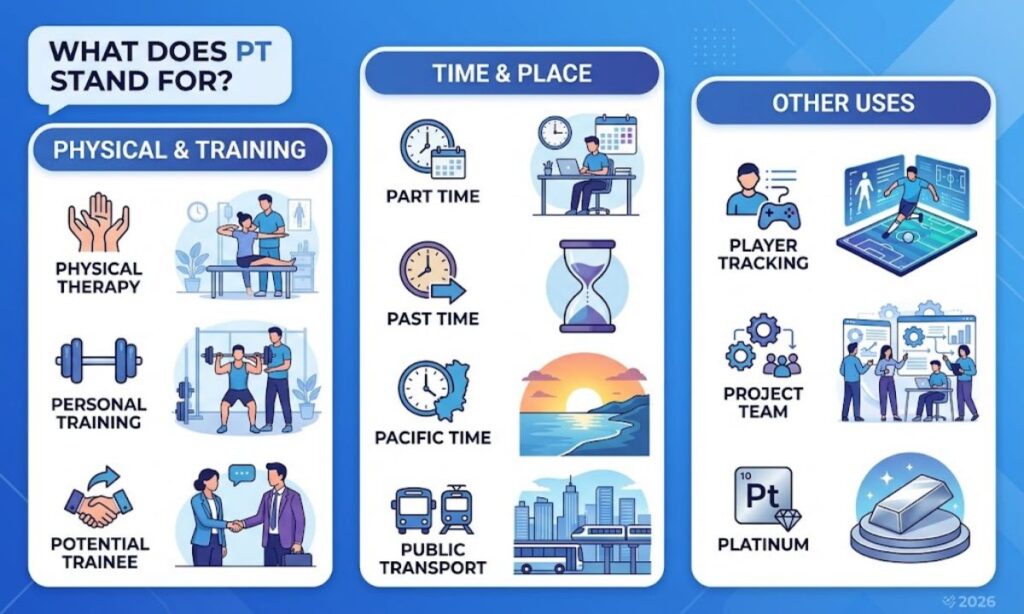
Here are ten meanings you may run into, with a short note on each.
- Part-time: Used for jobs and schedules, such as a part-time barista or tutor.
- Personal trainer: A fitness coach who designs workouts and tracks progress.
- Physical therapy: Treatment that helps people recover movement and strength.
- Pacific Time: The time zone used on the western coast of North America, common in event announcements.
- Physical touch: A love language based on hugs, cuddles, and closeness.
- Patient: Common in medical notes and healthcare conversations.
- Point: Sometimes used in games, sports, or scoring, as in “10 pt lead.”
- Portugal or Portuguese: The internet country code and a language label on websites and apps.
- Past tense: A grammar shorthand used by students and teachers.
- Pint: A measure for drinks, often seen in recipes and pub chat.
Most of these are rare in everyday texting. The first five cover the vast majority of what you will see.
How to Respond When Someone Uses PT
A good reply matches the meaning and the mood. If you are not sure what they mean, a friendly question is better than a wrong guess. Here are some options for different tones.
Casual Replies
- “Nice, how’s it going?”
- “Cool, what time do you finish?”
- “Sounds good, let me know how it goes.”
Funny Replies
- “Look at you, adulting with a schedule!”
- “Your trainer must be a legend. Or a villain.”
- “Part-time job, full-time chaos?”
Mature / Confident Replies
- “That sounds like a solid plan. How can I support you?”
- “Thanks for letting me know. I’ll adjust our schedule.”
- “Good to hear you’re staying consistent.”
Private / Respectful Replies (Medical Context)
When the topic is health, keep your response gentle and avoid prying into details.
- “I hope it’s going well. Let me know if you need anything.”
- “Thinking of you. Take it one day at a time.”
- “Glad you’re getting help. Rest up.”
If you want to ask what they meant, try: “Sorry, do you mean physical therapy or part-time?” People usually appreciate the question because it shows you care about getting it right.
Regional & Cultural Usage
Language habits differ around the world, and this abbreviation is no exception.
Western Culture
In the United States and Canada, it is extremely common for Pacific Time and personal trainer. Fitness culture is strong online, and many events are scheduled on the West Coast, so both meanings appear daily. Job listings also use it for part-time work.
Asian Culture
In many Asian countries, people use English abbreviations mixed with local languages. You may see it in job ads, gym posts, and clinic notes, but plain terms like “part-time” are also very common. Because of the time difference, people in places like Pakistan, India, and the Philippines often need to convert Pacific Time when joining international streams or webinars. Always double-check the zone before you set a reminder.
Middle Eastern Culture
In the Middle East, English abbreviations appear mainly in workplaces, universities, and healthcare. The medical meaning is well understood in hospitals and clinics, while younger people on social media use the fitness and time zone meanings. In conversations that mix Arabic and English, people often switch to the abbreviation for convenience, but they may spell things out when speaking to elders or in formal settings.
Global Internet Usage
Online, the abbreviation travels fast because it is short and flexible. Gamers, fitness fans, students, and remote workers all use it, each with their own meaning. The safest habit is the same everywhere. State the meaning once, then shorten it if you want.
Frequently Asked Questions
What does PT mean in a text message?
It most commonly means part-time, personal trainer, or physical therapy. Check the topic of the conversation to find the right one.
What does PT mean in a relationship?
It usually stands for physical touch, a love language. It can also be a joke about a part-time relationship.
Is PT the same as PST?
No. Pacific Time covers both standard and daylight saving periods, while PST refers only to Pacific Standard Time in winter.
Does PT mean personal trainer on social media?
Often yes, especially in fitness posts, but not always. Look at the account’s topic and the words around the abbreviation.
How do I know which meaning someone intends?
Read the surrounding words, think about the person’s life, and ask politely if you are still unsure.
Is it rude to ask what it means?
Not at all. A quick question is better than answering the wrong thing.
Is the abbreviation appropriate for professional emails?
Spell it out the first time, then use the short form if the meaning is clear to everyone.
Can it mean something negative?
Rarely. The meanings are neutral or positive, though the tone can be sarcastic if someone is joking about a part-time commitment.
Conclusion
Two small letters can stand for a job, a workout partner, a medical routine, a time zone, or a way of showing love. That flexibility is what makes the abbreviation useful and sometimes confusing. The best way to decode it is to look at the context, notice the tone, and ask if something does not add up. When you are the one writing it, add a clue or spell it out once so your message is clear. With that habit, you will read and send these messages with confidence.

Noah is a passionate content writer and language enthusiast who enjoys making difficult words, phrases, and text meanings easy to understand. She creates clear, simple, and useful articles with practical examples to help readers improve their vocabulary and everyday language skills.