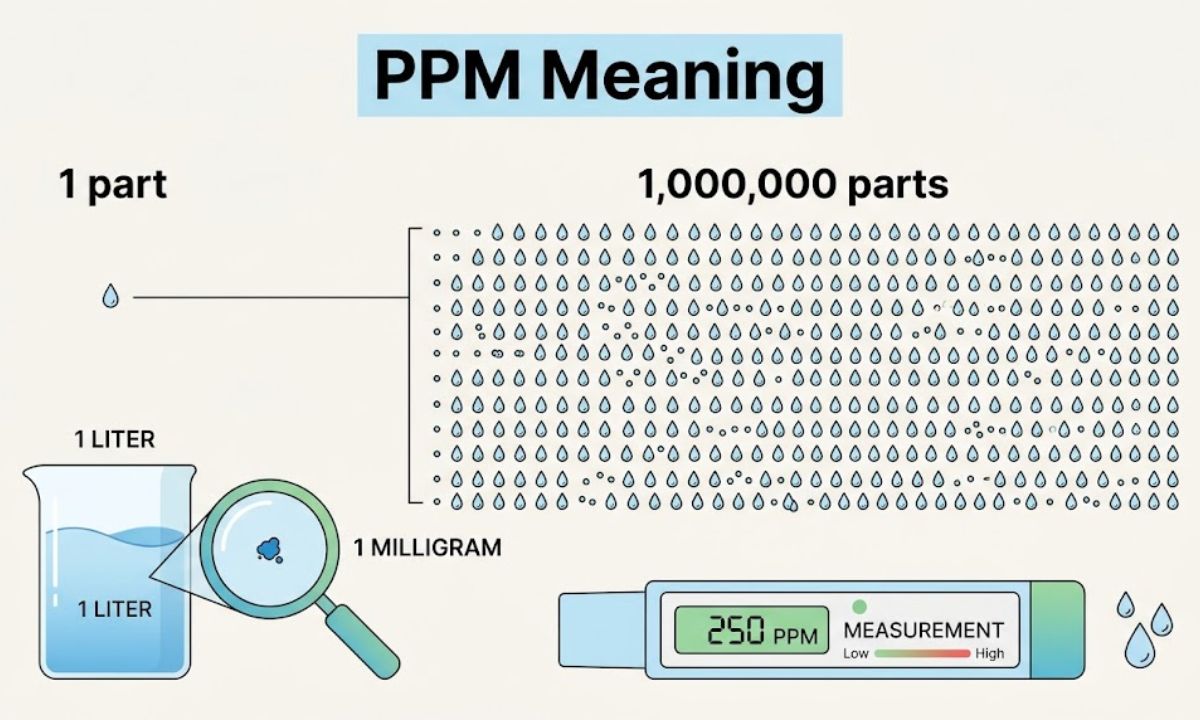
PPM means parts per million. It is a unit that shows how much of a substance is mixed into a million parts of something else. You will see it on water test strips, air quality reports, pool kits and factory quality sheets.
This guide covers the definition, the history, real chat examples, common mistakes and regional usage. Have you ever looked at a water test strip, a pool kit or a factory report and seen a number followed by “ppm”? meaning.
Many people nod and move on without knowing what it means. Yet this small unit decides whether your drinking water tastes right, whether your pool is safe to swim in, and whether a product passes quality checks.
Quick Explanation
Simple definition
PPM Meaning is short for parts per million. One PPM means one part of a substance in 1,000,000 parts of the total mixture. It is written as 1/1,000,000, or 0.0001%.
In plain words
Picture a swimming pool holding one million cups of water. If just one cup holds something unwanted, that is 1 ppm. The amount is tiny, but it can still matter.
Quick examples
- Water: 1 ppm equals about 1 milligram per liter (mg/L).
- Air: 50 ppm of carbon monoxide means 50 gas molecules in every million air molecules.
- Factory: 200 ppm defects means 200 faulty items per million produced.
- Percent link: 1% equals 10,000 ppm.
Origin & Background of PPM Meaning
Where it started
Scientists needed a way to describe very small amounts. Percent works for big shares, but it gets awkward with decimals like 0.0005%. “Parts per” notation fixed that. It scales a ratio to a million, so the numbers stay readable.
How it evolved
PPM first lived in chemistry labs. Over time, other fields adopted it:
- Environmental science used it for pollutants in air, soil and water.
- Manufacturing used it to count defects.
- Agriculture used it for nutrient and salt levels.
- Health agencies used it to set limits for contaminants and additives.
Modern influence
Today, PPM appears in everyday life. Home water testers, aquarium kits, hydroponic meters and climate reports all use it. Atmospheric carbon dioxide is also reported in ppm, and it now sits above 420 ppm.
Real-Life Conversations Using PPM Meaning (Mandatory Examples)
WhatsApp Chat – Home Water Filter
Sara: Bought a TDS meter today. My tap water shows 410 ppm. Is that bad?
Hamza: That’s not scary. Under 500 ppm is usually fine for drinking.
Sara: And after the filter?
Hamza: Test it. A good RO filter often brings it near 30–50 ppm.
Sara: Nice, testing now! 🙌
Workplace Slack Conversation
Manager: Our supplier’s defect rate last month?
Analyst: 1,800 ppm. That’s higher than our 500 ppm target.
Manager: So about 0.18% of parts are faulty?
Analyst: Exactly. It looks small, but at our volume it means thousands of bad units.
Manager: Flag it in the vendor review.
Instagram Comment on a Pool Cleaning Reel
@poolpro_amir: Keep free chlorine around 1–3 ppm. Test twice a week. 🏊
@summer_dips: Mine read 6 ppm yesterday. Too much?
@poolpro_amir: A bit high. Let it drop before swimming.
@summer_dips: Thanks, buying a better test kit! 👍
Emotional & Psychological of PPM Meaning
Why people care about it
PPM Meaning is about things we cannot see. We cannot spot chlorine, lead or carbon monoxide by eye. A number gives us control and calm. That is why people check their ppm readings the way others check the weather.
What mindset it reflects
Caring about PPM often shows a careful, detail-minded way of thinking:
- Precision: Small amounts matter.
- Prevention: Test early and avoid problems later.
- Responsibility: Protect family, customers and the environment.
- Curiosity: Many people start asking questions once they own a TDS meter.
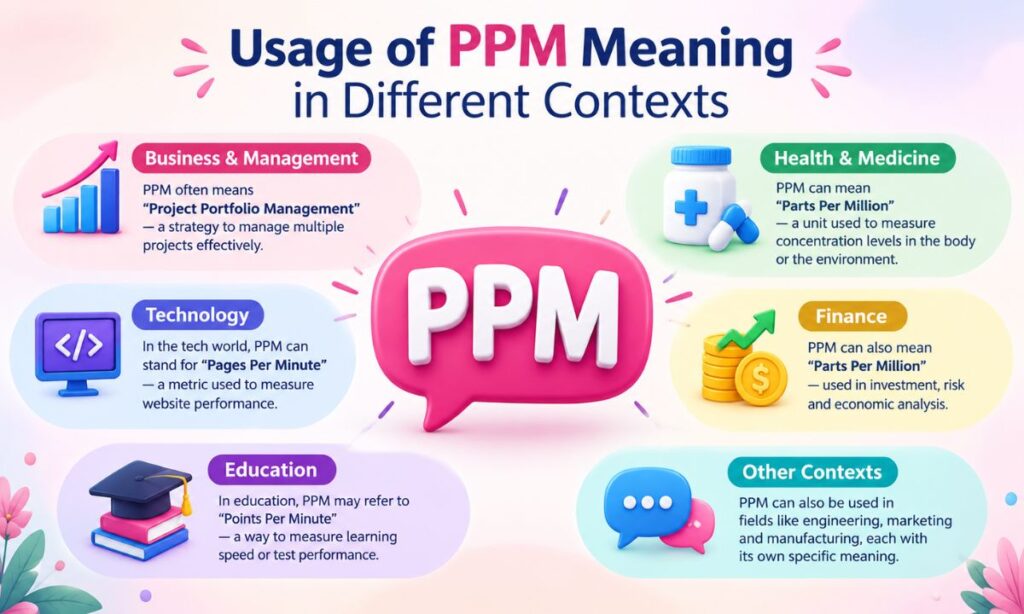
Usage of PPM Meaning in Different Contexts
1. Social Media
On social media, PPM Meaning shows up in pool care reels, aquarium tips, gardening videos and water filter reviews. Creators use it to sound credible. Viewers use it to compare results quickly.
2. Friends & Daily Life
Friends mention PPM when they talk about:
- Drinking water quality
- Fish tank or plant care
- Pool maintenance
- Air purifiers and gas alarms
3. Work & Professional Settings
Professionals rely on PPM in many fields:
- Quality control: Defective parts per million.
- Environmental teams: Emission and pollution limits.
- Food and beverage: Preservative and mineral levels.
- Healthcare and labs: Trace concentrations.
4. Casual vs Serious Usage
Casual use sounds like “My water is 200 ppm, nice.” Serious use is regulated, such as “Workplace exposure must stay under the legal ppm limit.” The unit is the same. The stakes are not.
Common Misunderstandings About PPM Meaning
1. Thinking PPM means percentage
PPM is not percent. One percent is 10,000 ppm. Mixing them up can lead to a 10,000-fold error.
2. Assuming small means harmless
A tiny number is not always safe. Carbon monoxide at a few dozen ppm can cause health problems. Lead and arsenic are risky at even lower levels.
3. Using PPM in the wrong context
PPM only makes sense alongside the thing being measured. “100 ppm” means nothing alone. Is it salt in water, gas in air or defects in a batch? Always name the substance.
PPM Meaning Comparison Table
| Unit | Meaning | Ratio | Common Use |
| Percent (%) | Parts per hundred | 1 in 100 | Everyday shares, discounts |
| PPM | Parts per million | 1 in 1,000,000 | Water, air, quality control |
| PPB | Parts per billion | 1 in 1,000,000,000 | Trace pollutants |
| PPT | Parts per trillion | 1 in 10¹² | Ultra-trace analysis |
| mg/L | Milligrams per liter | ≈ 1 ppm in water | Lab water reports |
Variations / Types of PPM Meaning (Common Uses)
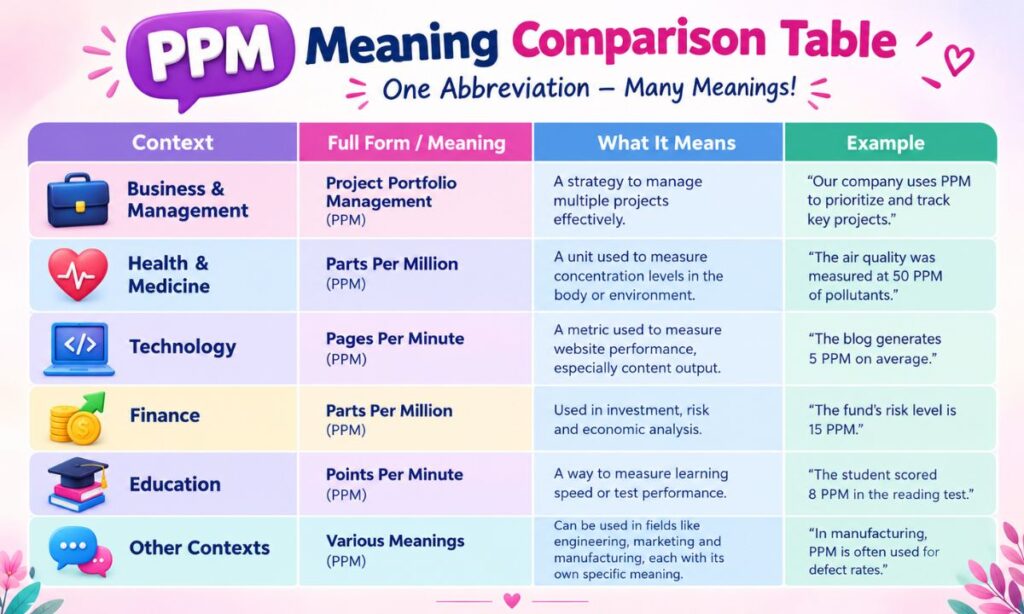
The letters PPM can mean different things depending on the field:
| Variation | Full Form | Where You See It |
| Concentration PPM | Parts per million | Chemistry, water, air |
| Defect PPM | Defective parts per million | Manufacturing, supply chains |
| Pages per minute | Print speed | Printers and copiers |
| Project portfolio management | Business planning | Project and IT offices |
| Pixels per meter | Image resolution | Imaging and mapping |
| Pulse-position modulation | Signal encoding | Electronics, communications |
Context decides which one applies. If you are unsure, ask what is being measured.
How to Respond When Someone Uses “PPM”
Casual Replies
- “Oh nice, what’s the reading?”
- “Is that high or normal?”
- “Which test kit did you use?”
Funny Replies
- “Look at you, a backyard scientist! 🔬”
- “Parts per million? I can barely count my parts per day.”
- “Did your pool just pass a chemistry exam?”
Mature & Confident Replies
- “That’s within the recommended range. Keep monitoring it.”
- “Let’s retest it to confirm the number.”
- “Which standard are you comparing against?”
Private or Respectful Replies
- “Thanks for sharing. Want me to explain what it means?”
- “Happy to look at the report with you privately.”
- “Let’s check with a qualified expert if you are worried.”
How to Calculate PPM (Formula & Easy Examples)
PPM is a simple ratio. You divide the amount of the substance by the total amount, then multiply by one million.
Formula:
PPM = (amount of substance ÷ total amount) × 1,000,000
Both amounts must use the same unit, such as grams to grams.
Example 1: Salt in water
You dissolve 0.5 g of salt in 1,000 g of solution.
0.5 ÷ 1,000 = 0.0005, and 0.0005 × 1,000,000 = 500 ppm
Example 2: Defects in a factory
A batch has 25 defective items out of 50,000 produced.
25 ÷ 50,000 = 0.0005, and 0.0005 × 1,000,000 = 500 ppm
Example 3: Water shortcut
In water, 1 mg per liter is about 1 ppm. If 15 mg of a mineral is dissolved in 3 liters, that is 5 mg/L, or about 5 ppm.
Quick conversions
- Percent to PPM: multiply by 10,000 (0.02% = 200 ppm).
- PPM to percent: divide by 10,000 (500 ppm = 0.05%).
- PPM to PPB: multiply by 1,000.
Common PPM Meaning Levels and What They Mean
Numbers make more sense with a benchmark. The table below lists typical reference points. Limits change by country and by use, so always check your local standard.
| Where You See It | Typical PPM Reference | What It Means |
| Drinking water (TDS) | Under 300 ppm | Often considered excellent taste |
| Drinking water (TDS) | 300–500 ppm | Generally acceptable |
| Drinking water (TDS) | Above 500 ppm | Above the common guideline; may taste salty or bitter |
| Swimming pool (free chlorine) | 1–3 ppm | Common range for safe, clean pool water |
| Fluoride in tap water | About 0.7 ppm | Level recommended by US health agencies for dental health |
| Outdoor air (carbon dioxide) | Above 420 ppm | Current global atmospheric level |
| Workplace air (carbon monoxide) | 50 ppm (8-hour limit in the US) | Exposure above this can be dangerous |
| Manufacturing quality | Under 100 ppm defects | Often seen as high-quality production |
Regional & Cultural Usage of PPM Meaning
Western Culture
In the US, UK and Europe, PPM is common in water reports, pool care, environmental regulation and manufacturing audits. Home owners often meet it through municipal water quality notices.
Asian Culture
In countries across South and East Asia, many households use a TDS meter to check water. People often compare tap, boiled and filtered water by their ppm numbers. The unit is also common in electronics and factory supply chains.
Middle Eastern Culture
Water scarcity makes PPM especially relevant. Desalinated and groundwater sources are monitored closely, and salinity is regularly discussed in ppm. Agriculture and aquaculture also depend on it.
Global Internet Usage
Online, PPM is understood almost everywhere in its scientific sense. The international system treats it as a ratio, so the idea is consistent worldwide. Only local limits and regulations differ.
Frequently Asked Questions
1. What does PPM mean in simple words?
PPM means parts per million: how many parts of a substance exist in one million parts of a mixture.
2. Is higher PPM always bad?
No. It depends on the substance. High ppm of an unwanted contaminant is bad, but some minerals or nutrients are needed in certain ranges.
3. Is PPM used only in science?
No. It is also used in manufacturing, farming, pool care and printing, where it can mean defects or pages per minute.
4. What is a safe PPM level?
It varies by substance. For drinking water, total dissolved solids under 500 ppm is a common guideline, but always check local standards.
5. How is PPM calculated?
Divide the amount of the substance by the total amount, then multiply by 1,000,000. In water, 1 mg/L is about 1 ppm.
6. Is PPM the same worldwide?
Yes, the definition is the same everywhere. Only the legal limits and testing standards differ by country.
Conclusion
PPM is more than a scientific term. It helps us see the invisible, from water minerals to pool chemicals to factory defects. It turns tiny amounts into numbers we can act on.
Let’s recap what we covered. PPM means parts per million: one part of a substance in one million parts of a mixture. In water, 1 ppm is roughly 1 mg/L. Compared with percent, it is much smaller, since 1% equals 10,000 ppm. The unit began in chemistry, then spread to environmental science, farming, manufacturing and even social media, where people share their readings every day.

Noah is a passionate content writer and language enthusiast who enjoys making difficult words, phrases, and text meanings easy to understand. She creates clear, simple, and useful articles with practical examples to help readers improve their vocabulary and everyday language skills.