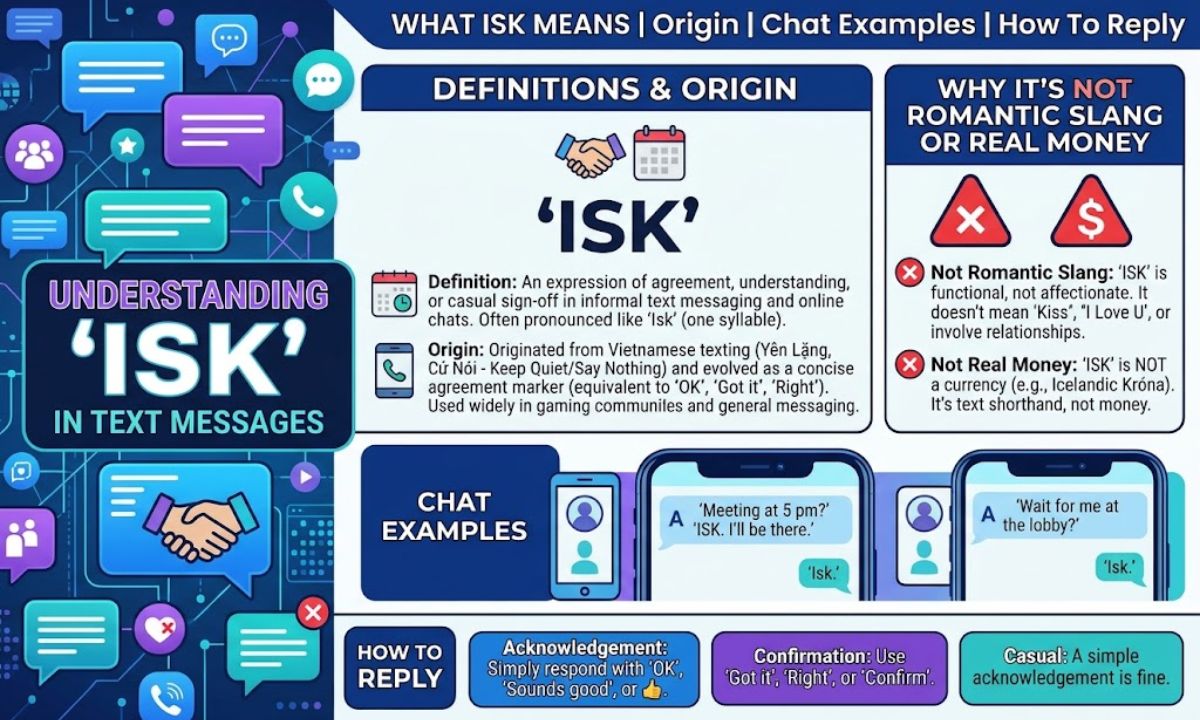
Scroll through a gaming chat and you will see big numbers followed by three capital letters. Those letters are ISK. They have nothing to do with romance, emotional slang, or your bank balance. This guide covers what the term means, where it came from, how people use it, and how to reply without sounding lost.
ISK Meaning in Text – Quick Definition

In text, ISK stands for Interstellar Kredits, the virtual currency of the space MMO EVE Online. When a player types a number followed by this word, they are talking about in-game money: the price of a ship, a market profit, a bounty payout, or a loss after a failed trade.
Quick Summary
- Full form: Interstellar Kredits
- Where it appears: EVE Online chats, Discord servers, forums, Reddit threads, and gaming group chats
- Tone: casual, gamer slang
- What it is not: romantic slang, a general texting abbreviation, or real money
Simple Examples
- “I need 300 million ISK before I can buy that new frigate.”
- “Sold all the loot from the mission, made 2B today.”
- “Can you lend me some for the fuel? I’ll pay you back tomorrow.”
Notice that people often drop the word entirely once the topic is clear. In a group of EVE players, “2B” or “400M” already means in-game currency.
Origin & Background of ISK Meaning
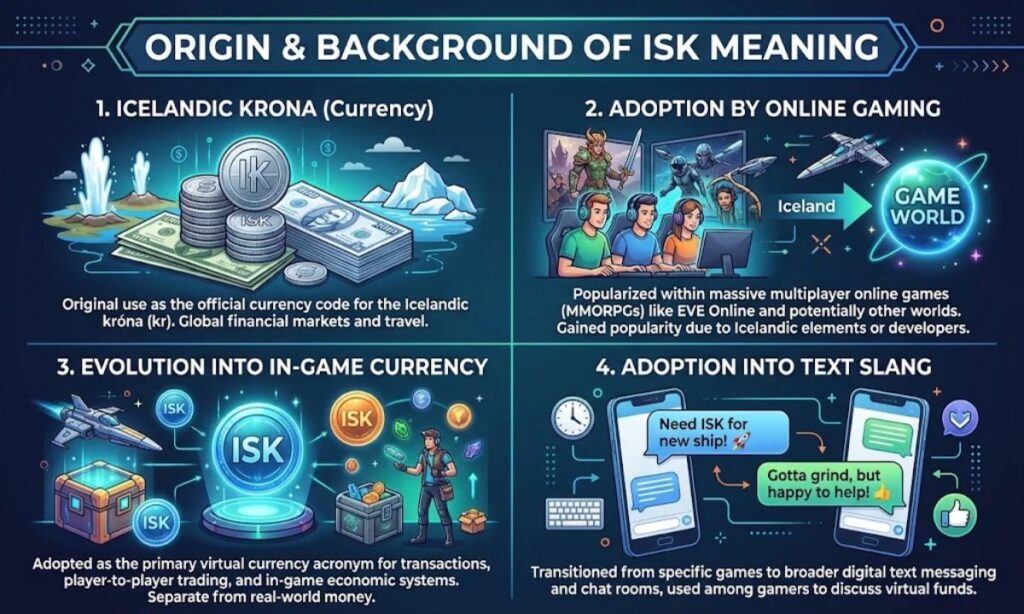
CCP Games, the Reykjavik studio behind EVE Online, borrowed the abbreviation from the Icelandic króna, which uses ISK as its international currency code. The nod to the developer’s home country was a small, practical choice. The studio needed a currency name that sounded futuristic, so “Interstellar Kredits” was built to fit the three letters.
EVE Online launched in 2003. It is known for its single shared universe, player-run corporations, and an economy that behaves much like a real one, with supply and demand, inflation, speculation, and scams. In a game where wealth decides who can build fleets, fund wars, and control territory, the currency naturally became the main topic of conversation.
How the Term Spread
The term spread in three stages:
- In-game chat. Early players used it in local and corporation channels to quote prices.
- Forums and fan sites. Market guides, trade discussions, and wealth-building tutorials made the word common vocabulary.
- Social platforms. As streamers, YouTubers, and TikTok creators covered the game’s economic drama, the word reached people who had never played. Some of them then asked what it meant, which is probably why you are reading this.
Today the word travels well beyond the game itself. Players use it as shorthand for wealth, risk, and reward, even in conversations that have nothing to do with spaceships.
Real-Life Conversations Using ISK
The best way to understand slang is to see it in context. Here are realistic examples of how it shows up across platforms.
WhatsApp Conversation
Sami: Did you check the market today?
Daniel: Yeah, the price of that ship dropped hard. I bought three.
Sami: Nice. How much did you spend?
Daniel: About 900M total. I’ll sell them next week when demand goes back up.
Sami: Risky, but I like it. Just don’t tell the corp until it works 😂
Here the currency is understood without being named. In a private chat between players, repeating it would feel unnecessary.
Instagram DM
Ayesha: My brother keeps talking about billions. Is he rich?
Hamza: Haha, only in the game. He means ISK, the currency in EVE Online.
Ayesha: Oh thank goodness. I was about to ask for a loan 😅
This exchange shows the most common real-life confusion: a non-player sees large numbers and assumes real wealth.
TikTok Comments
“Lost 5 billion in one fight, my wallet is crying 😭”
“Welcome to EVE, where ships are expensive and regret is free”
“Bro that’s a whole year of grinding gone in two minutes”
Comment sections on gaming clips use the term as a punchline. Big losses and big wins are the content, and the numbers carry the joke.
Text Message Between Friends
Jordan: Are you coming tonight?
Mike: Can’t, I’m hauling cargo across 40 jumps. If it gets caught, I’m broke.
Jordan: Priorities, I see. Good luck, space trucker.
The word may not appear at all, but the stakes are clearly about in-game money.
Emotional & Psychological Meaning
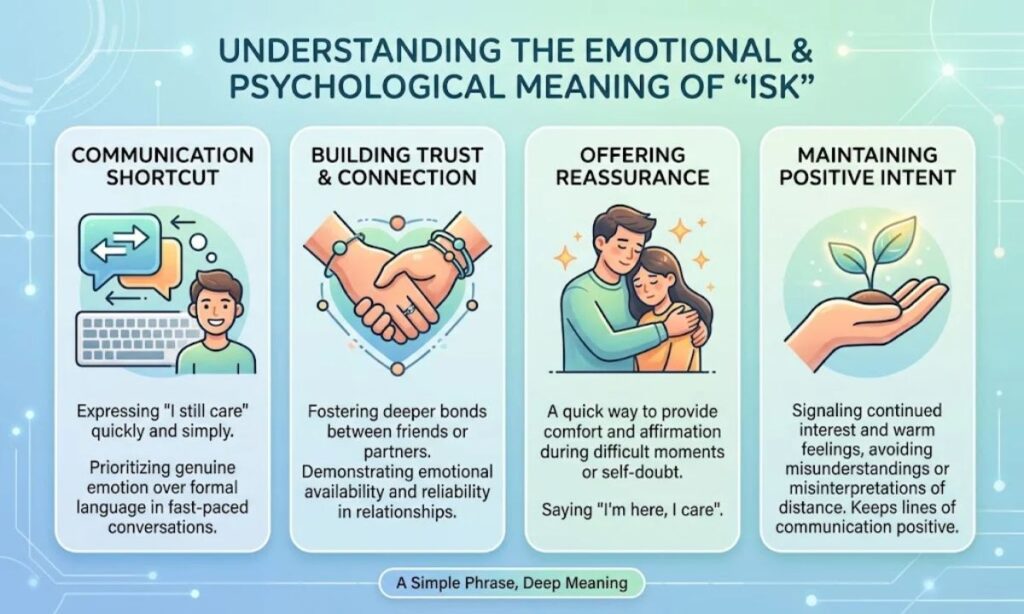
Behind the numbers sits a lot of feeling. In EVE, losing a ship can mean losing hours of work, so a single fight can swing a player’s mood. Calling something “just pixels” rarely comforts someone who spent three weeks earning it.
Why Players Care About ISK
- Effort and time. Currency represents hours of mining, trading, or mission running. A big balance feels like proof of persistence.
- Status and power. Wealth buys better ships and wider influence, which lifts standing in a corporation or alliance.
- Risk and thrill. Gambling a fleet on a single fight produces real adrenaline, and winning feels earned.
- Community identity. Sharing stories about huge wins, devastating scams, and spectacular losses bonds players together. The EVE community is famous for its legendary heists and betrayals.
Understanding this emotional layer helps when you reply. A friend who says “I just lost everything” may be joking, but the frustration is often genuine. A little empathy goes a long way.
Usage in Different Contexts
Social Media
On platforms like X, Reddit, TikTok, and YouTube, the word works as in-group shorthand. Creators use it in titles (“How I made 10 billion in a week”), and viewers use it in comments to react, joke, or ask for advice. Hashtags and clips usually give enough context that newcomers can follow along.
Friends & Gaming Communities
This is the term’s natural home. In Discord servers and in-game channels, people quote prices, ask for loans, arrange trades, and brag about profits. Here it is a practical, everyday word, no more unusual than “gold” in other games.
Work or Professional Settings
In most workplaces it simply doesn’t belong. If you use it with colleagues who don’t play, you will probably get puzzled looks. The exception is gaming-related jobs, such as community management, esports, game journalism, or market analysis for virtual economies, where the vocabulary is part of the work.
Casual vs Serious Tone
- Casual: jokes, memes, bragging, and complaining about losses.
- Serious: economic analysis, corporation finances, and trade planning. Some EVE players write detailed spreadsheets and market reports.
The tone depends on the audience. Among friends the word is playful. In an economic discussion it becomes a unit of measurement.
Common Misunderstandings
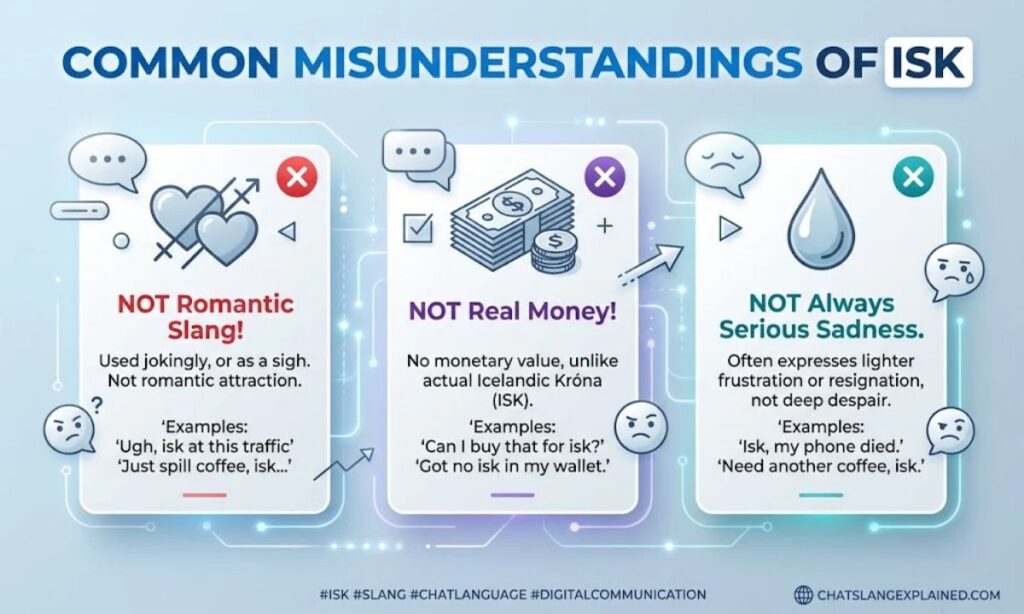
Mistake 1: Thinking It’s Romantic Slang
Some people see three letters in a message and assume it is a flirty or emotional abbreviation. It isn’t. If a gamer says they are “farming” this currency, nobody is being romantic. They are probably mining asteroids.
Mistake 2: Confusing It With Real Money
Here is the source of most confusion. ISK is also the official international code for the Icelandic króna, so a banking app or a travel site may use it for real money. In gaming chat, though, it means the virtual currency. Check the context. Talk of ships, fleets, and market orders points to the game. Talk of travel, exchange rates, or Reykjavik points to Iceland.
Mistake 3: Using It in Normal Conversations
Dropping the term into everyday chat with non-gamers rarely works. It is niche slang, not a mainstream abbreviation like “BRB” or “LOL.” If your audience isn’t familiar with the game, explain it or choose plainer words.
Comparison Table
| Term | Meaning | Typical Context | Real Money? |
| EVE currency | Interstellar Kredits, in-game money | EVE Online chat, forums | No |
| Icelandic króna | Iceland’s national currency code | Banking, travel, exchange rates | Yes |
| IDK | “I don’t know” | Everyday texting | No |
| Gold / GP | In-game money in other games | WoW, RuneScape, and others | No |
Keep this table in mind the next time you see unfamiliar letters in a message. Context decides everything.
Variations and Related Terms
1. Grinding ISK
Repeating tasks such as missions, mining, or hauling to earn currency steadily. It is the least glamorous but most reliable way to build a balance.
2. ISK Farming
A more systematic version of grinding. Players use efficient routes, optimized ships, or multiple accounts to maximize hourly earnings.
3. ISK Wallet
The in-game account balance. Players check it constantly, and “wallet is empty” is a common joke after an expensive purchase.
4. ISK Profit
Earnings after expenses. Smart traders track profit carefully, because a sale that looks big can still lose money once fees and taxes are counted.
5. ISK Market
The player-driven marketplace where nearly everything is bought and sold. Prices rise and fall with supply, demand, and sometimes manipulation.
6. ISK Trade
Buying low and selling high. Some players trade full-time and treat it like a career inside the game.
7. ISK Transfer
Sending currency directly to another player, usually for a trade, a loan, or a corporation payment. Scammers love this moment, so verify before you send.
8. ISK Loss
What happens when a ship is destroyed or a deal goes wrong. Players often share loss stories with a mix of pain and humor.
9. ISK Investment
Putting currency into ships, skills, assets, or market stock with the hope of a larger return later. It carries real risk, even if the money is virtual.
10. ISK Economy
The overall flow of money, goods, and services across the game universe. Economists have studied it as a living example of a virtual market.
How to Respond When Someone Uses ISK
Your reply depends on the relationship and the mood. Here are options.
Casual Replies
- “Nice, that’s a solid profit.”
- “Ouch, that’s a lot to lose. Rebuilding time?”
- “How long did that take you to earn?”
Funny Replies
- “Space capitalism at its finest 😂”
- “So you’re rich and broke at the same time?”
- “Can I borrow a billion? I’ll pay you back in memes.”
Mature / Confident Replies
- “Smart move. Diversifying across ships and market orders reduces your risk.”
- “That’s a rough loss, but the recovery is part of the game. What’s your plan?”
Respectful Private Replies
If a friend sounds genuinely upset after a big loss, keep it simple and kind:
- “That sounds frustrating. Want to talk it through?”
- “Sorry about that. You’ve bounced back before, you’ll do it again.”
Reading the mood matters more than knowing the slang.
Regional & Cultural Usage
Western Gaming Communities
In North America and Europe, where EVE has its largest player base, the word is common among players. Community culture leans toward dry humor, long-running rivalries, and detailed economic debate.
Asian Gaming Culture
Asian players are active in the game, though they often form regional corporations and use local-language chat. The same word is used, but the surrounding slang may mix English abbreviations with local expressions. Large trading groups and market analysts have emerged in several Asian communities.
Middle Eastern Communities
Players in the Middle East and South Asia often use English gaming terms inside chats written in local languages, so the word appears unchanged within Arabic, Urdu, or Hindi conversations. For many of them, online gaming groups double as social spaces, and talking about earnings is a way to bond.
Global Internet Usage
Because the game has a single shared server, players from every region trade, fight, and chat together. That keeps the vocabulary consistent worldwide. A player in Lahore, Toronto, and Tokyo will all understand the same message, which helps explain why the term has spread so widely.
Frequently Asked Questions
What does ISK mean in text?
In gaming contexts it means Interstellar Kredits, the virtual currency of EVE Online. It is not a general texting abbreviation.
Is it real money?
No. The in-game currency has no official cash value, and the game’s rules restrict trading it for real money. Be careful with anyone offering to sell it for cash, because those offers often lead to scams and account bans.
Why does it look like a banking term?
Because the same three letters are the international code for the Icelandic króna. The game’s developers borrowed the code from their home country.
Can I use it in everyday texts?
Only with people who play or understand the game. Otherwise it will cause confusion.
Is it used in other games?
Mostly no. Other games use their own currency names, such as gold, coins, credits, or gil. This term belongs to EVE Online and its community.
How do players earn it?
Common methods include mining, running missions, trading on the market, manufacturing, hauling, and fighting. Each style suits a different personality and risk level.
Why do some players talk in billions?
The game’s economy has inflated over time, and advanced ships and assets cost huge sums. Veteran players regularly handle balances that sound absurd to newcomers.
Should I worry when a friend mentions big losses?
Usually not. It’s almost always a game conversation. If a friend sounds distressed about real-life money, ask directly what’s going on.
Conclusion
ISK is a small word with a big story. It started as a currency code borrowed from Iceland, became the heartbeat of one of gaming’s most unusual economies, and now shows up in chats, comment sections, and memes around the world. In text it almost always means in-game money from EVE Online. It isn’t romantic slang and it isn’t a casual abbreviation for everyday conversation.
The key to understanding it is context. Gaming platforms, big numbers, and talk of ships or markets point to the virtual currency. Banking apps, travel plans, and exchange rates point to the Icelandic króna. Once you know the difference, you can reply naturally, with humor, curiosity, or a little sympathy after a painful loss.
If you ever feel unsure, ask. Gamers love explaining their worlds, and a simple “Wait, what does that mean?” usually starts a good conversation.

Noah is a passionate content writer and language enthusiast who enjoys making difficult words, phrases, and text meanings easy to understand. She creates clear, simple, and useful articles with practical examples to help readers improve their vocabulary and everyday language skills.