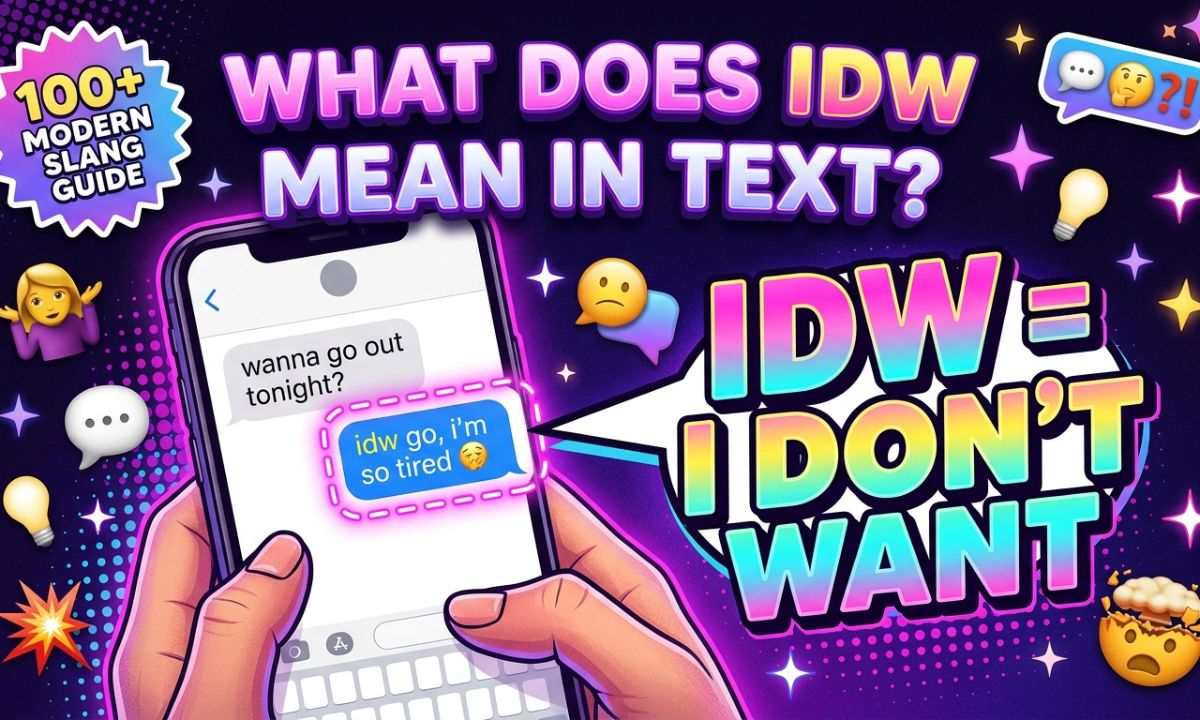
IDW most often means “I don’t want” (or “I don’t want to”) in text messages. People use it to say no, decline plans, or admit they have no motivation. It is short, casual, and common in chats on WhatsApp, Instagram, and Snapchat.
If someone just sent you “idw” and you are not sure what to say back, this guide has you covered. You will learn the IDW meaning in text, where it came from, how to reply, and when to avoid it. You will also see more than 100 ways the phrase shows up in everyday chats, from simple refusals to playful jokes.
IDW – Quick Meaning

IDW is a text abbreviation built from the phrase “I don’t want.” It is part of the same family as IDK (I don’t know), IDC (I don’t care), and IDR (I don’t remember).
Simple Definition
IDW = I Don’t Want (to).
It works as a quick refusal or a low-energy reply. The tone depends on the words around it and on how well the two people know each other.
Here is a fast summary:
- Full form: I don’t want / I don’t want to
- Type: Texting abbreviation, internet slang
- Tone: Casual, blunt, sometimes tired or playful
- Best for: Friends, family, social media, group chats
- Avoid in: Formal emails, job applications, business messages
Example Text Messages
Here are a few simple ways people use the IDW meaning in text:
- “Want to go out tonight?” → “idw, i’m so tired.”
- “Can you help me move?” → “idw but ok fine.”
- “Do you want pizza?” → “idw pizza again lol.”
- “Come to the gym.” → “idw to get up.”
- “Let’s study.” → “idw. my brain is off.”
Notice that each message sounds casual. IDW usually comes with a short reason or a joke.
Origin & Background of IDW Mean
The exact origin of IDW is unclear, like most internet slang. No single person invented it. It grew naturally from a long habit of shortening common phrases in chats.
The pattern is simple. Take the letter “I” and add the first letters of the next words. That gives IDK, IDC, IDR, and then IDW. Once people got used to the first few, new ones were easy to guess.
It is also worth knowing that IDW has other meanings outside texting. In science it can stand for Inverse Distance Weighting, a mapping method. In health it can mean Ideal Body Weight. In publishing, IDW refers to a comic book company. Always check the setting before you decide which one applies.
Influence of Messaging Apps
Messaging apps shaped this kind of slang in a big way. Early phones had tiny keypads and strict character limits. Typing fewer letters saved time and money.
Today those limits are gone, but the habit stayed. Fast apps, voice notes, and Stories reward quick replies. Short forms like IDW feel natural, relaxed, and a little lazy in a fun way.
Social platforms also helped it spread:
- WhatsApp and iMessage made fast back-and-forth chats the norm.
- Instagram and Snapchat pushed younger users toward short, informal replies.
- TikTok comments made lowercase, abbreviated slang look cool and relatable.
Real-Life Conversations
Seeing IDW Mean in real chats makes the meaning clear. These are sample conversations, written to show tone and context.
WhatsApp Chat
Ali: Are you joining the family dinner?
Sara: idw, i had a long day.
Ali: Okay, rest then. I’ll save you a plate.
Here, IDW means Sara is tired and would rather stay home. Ali takes it kindly and offers a warm reply.
Instagram DM
Mia: You should post that reel today.
Zoe: idw, my edits look bad.
Mia: They look great! Just post it.
In this chat, IDW shows self-doubt. Zoe is not being rude. She is worried about how the reel looks.
Text Message Conversation
Jake: Want to play games later?
Leo: idw rn. maybe tomorrow?
Jake: Sure, no stress.
Leo adds “rn” (right now) to soften the refusal. It tells Jake that the answer is not a hard no.
Emotional & Psychological Meaning
IDW Mean can say more than “no.” It often hints at how a person feels. Here are four common emotional meanings behind it.
1. Lack of Motivation
Sometimes IDW means the person feels drained or unmotivated. They are not angry. They just have no energy.
- “idw do homework today.”
- “idw cook, let’s order.”
If a friend says this often, a gentle check-in can help.
2. Boundary Setting
IDW can be a simple way to set a limit. Short and clear, it tells others where a person stands.
- “idw talk about it.”
- “idw go there tonight.”
In this case, respect the boundary. Do not push for a long explanation.
3. Casual Honesty
Many people use IDW to be direct without writing a long message. It saves them from making excuses.
- “idw lie, i’m not interested.”
- “idw come, but thanks for asking.”
This style feels honest and light, especially between close friends.
4. Avoidance
Sometimes IDW Mean is a way to dodge something uncomfortable, such as a hard talk or a stressful task.
- “idw think about exams.”
- “idw deal with it now.”
If the pattern repeats, the person may need support, not pressure.
Usage in Different Contexts
The IDW meaning in text stays the same, but the right way to use it changes with the setting.
Social Media
On Instagram, Snapchat, and TikTok, IDW appears in captions, comments, and Stories. It is usually playful.
- Caption: “monday again. idw.”
- Comment: “idw leave this beach 😭”
Friends & Relationships
With friends, IDW Mean feels easygoing. In relationships, tone matters more. A short “idw” can feel cold if there is no explanation, so add a few extra words.
- Friends: “idw go out, movie night at mine?”
- Partner: “idw argue tonight. Can we talk tomorrow?”
Work or Professional Settings
Avoid IDW in formal work messages. It can sound blunt and unprofessional. Use full sentences instead.
- Instead of “idw attend,” write “I won’t be able to attend.”
- Instead of “idw do this,” write “I’d prefer not to take this on.”
In a relaxed team chat, it may be fine, but check the culture first.
Casual vs Serious Tone
| Tone | Example | What it signals |
| Casual | “idw cook lol” | Lazy, joking, relaxed |
| Playful | “idw leave bed 😭” | Dramatic, funny |
| Serious | “idw do this anymore.” | Real frustration or limit |
| Soft | “idw rn, maybe later?” | Polite delay |
Emojis, punctuation, and extra words help show the real tone.
Common Misunderstandings
Slang is easy to misread. Here are three mistakes people make with IDW.
Mistake 1: Thinking It Means “I Don’t Worry”
Some people read the W as “worry.” That is not correct. “Don’t worry” is shortened to DW, not IDW. IDW is “I don’t want.”
Mistake 2: Assuming It’s Rude
IDW can sound sharp in plain text, but it is often just tired or honest. Look at the context before you take offense. If you are unsure, ask a friendly follow-up.
Mistake 3: Using It in Formal Situations
Sending IDW to a manager, teacher, or client can look careless. Save it for friends and casual chats.
Comparison Table
This table shows how IDW compares with other similar abbreviations.
| Slang | Full form | Meaning | Tone |
| IDW | I don’t want | Declining or lacking desire | Casual, direct |
| IDK | I don’t know | Not sure | Neutral |
| IDC | I don’t care | Indifferent | Can feel dismissive |
| IDR | I don’t remember | Forgot | Neutral |
| IDM | I don’t mind | Flexible | Easygoing |
| DW | Don’t worry | Reassurance | Friendly |
| IDTS | I don’t think so | Mild disagreement | Polite doubt |
Variations and Similar Expressions
Several longer forms and related phrases appear in chats. Some are informal and less common, so their meaning depends on context.
1. IDWTT
Often read as “I don’t want to talk.” It signals a need for space.
2. IDWK
Often read as “I don’t want to know.” Used when someone wants to avoid details.
3. IDWM
Usually read as “I don’t want to meet” or “I don’t want me to.” Context decides.
4. IDWR
Can mean “I don’t want to reply.” It shows a lack of energy for chatting.
5. DW
Short for “don’t worry.” It is used to comfort someone.
6. IDC
Stands for “I don’t care.” It is stronger and can sound cold.
7. IDTS
Means “I don’t think so.” It is a polite way to doubt or disagree.
8. NTY
Means “no thank you.” It is a polite refusal.
9. Meh
A word for mild disinterest. It is softer than IDW.
10. Pass
A quick way to say no to an offer. “Pass, thanks” is common and clear.
How to Respond When Someone Uses IDW
Your reply depends on your bond and on how the other person sounds. Here are options for different situations.
Casual Replies
- “No worries, maybe next time.”
- “All good, just let me know.”
- “Okay, we can do it later.”
Funny Replies
- “Same, my bed is calling me too.”
- “Fair, I also don’t want things today.”
- “Okay, but the snacks will miss you.”
Mature or Confident Replies
- “That’s fine. Thanks for being honest.”
- “No problem. I’ll plan around it.”
- “Understood. Let me know if that changes.”
Respectful or Private Replies
- “Take your time. I’m here if you want to talk.”
- “No pressure at all.”
- “I respect that. Rest up.”
A kind reply keeps the chat warm and shows you accept their choice.
Regional & Cultural Usage
IDW is rooted in English, but people everywhere use English slang online. Style and tone still vary by culture.
Western Culture
In the US, UK, and Canada, direct refusals are common and accepted among friends. IDW fits right in, especially in lowercase texts.
Asian Culture
In many Asian communities, people prefer softer, more polite refusals. IDW is often paired with an apology, an emoji, or a reason, such as “idw today, sorry 🙏.”
Middle Eastern Culture
Hospitality and politeness matter a lot. A blunt IDW may feel too sharp to elders or guests, so people often add kind words or switch to a gentler phrase.
Global Internet Usage
Online, young users share similar slang across borders. IDW appears in chats, comments, and gaming lobbies worldwide. Still, the safest approach is to match the tone of the person you are talking to.
FREQUENTLY ASKED QUESTIONS
What does IDW mean in text?
IDW means “I don’t want” or “I don’t want to.” It is a casual way to decline or show a lack of desire.
Is IDW the same as IDC?
No. IDW means “I don’t want,” while IDC means “I don’t care.” They express different feelings.
Is IDW rude?
Not usually. It can sound blunt, so add a reason or a friendly word to soften it.
Does IDW mean “I don’t worry”?
No. “Don’t worry” is shortened to DW. IDW stands for “I don’t want.”
Can I use IDW at work?
It is best to avoid it in formal work messages. Use a full, polite sentence instead.
What is the difference between IDW and IDK?
IDW shows you do not want something. IDK shows you do not know something.
How do I reply to IDW?
Reply with understanding, such as “No worries, maybe next time.” Keep it light and respectful.
Is IDW used on Snapchat and Instagram?
Yes. It appears often in DMs, comments, and captions on both platforms.
Does IDW have other meanings?
Yes. Outside texting, it can mean Inverse Distance Weighting, Ideal Body Weight, or IDW Publishing.
Is IDW capitalized?
Either way works. Most people type it in lowercase for a relaxed tone.
Conclusion
Now you know the full IDW meaning in text. It stands for “I don’t want,” and it is a quick, casual way to say no, set a boundary, or share low energy. The tone depends on context, so read the whole message before you react.
Here are the key points to remember:
- IDW means “I don’t want (to).”
- It is casual and best for friends and informal chats.
- It is different from DW, IDC, and IDK.
- Add a reason or emoji to keep the tone soft.
- Skip it in formal or professional messages.
Next time someone sends you “idw,” you will know exactly what they mean and how to reply with kindness. Keep your texts clear, friendly, and true to your own voice.

Noah is a passionate content writer and language enthusiast who enjoys making difficult words, phrases, and text meanings easy to understand. She creates clear, simple, and useful articles with practical examples to help readers improve their vocabulary and everyday language skills.